














National Health Insurance Authority (NHIA, formerly NHIS) in Nigeria: A 2026 Enrolment Guide
Author Noella Lepdung
Introduction
If you’ve been searching for the NHIS, here is the first thing to know. The National Health Insurance Scheme (NHIS) no longer exists as a separate body. It is now the National Health Insurance Authority (NHIA), following the NHIA Act signed in May 2022.
This guide is for any Nigerian who wants health cover in 2026, whether you’re salaried, self-employed, or running a small business. It explains what changed, who must enrol, how to register step by step, and what it’s likely to cost. For the full legal picture of what “mandatory cover” actually means under the Act, see our pillar on the NHIA Act 2022 and what mandatory health insurance means for you.
The three things to know before you enrol
Formal-sector employees (companies with 5+ staff) are enrolled through their employer under OPSSHIP. Self-employed Nigerians and families enrol themselves through GIFSHIP via an NHIA-accredited HMO.
Vulnerable groups (indigent, pregnant women, under-fives) are covered free through the Vulnerable Group Fund. Everyone else pays an annual premium that varies by HMO, plan tier and dependants.
Table of contents
What the NHIA is, and why you need cover
The National Health Insurance Authority is Nigeria’s government agency for expanding access to affordable healthcare through insurance. Its job is to make sure Nigerians can pay for quality care without facing crushing out-of-pocket bills.
This matters because most Nigerians still pay for treatment from their own pocket. Surveys have repeatedly shown that a large majority of adults fund their health costs directly, and only a small share hold any insurance. When a serious illness strikes, that gap can push a family into real financial hardship, and the real cost of going without cover usually only becomes clear once something goes wrong.
Health insurance spreads that risk. You pay a set premium, and your accredited Health Maintenance Organisation (HMO) and hospital handle covered treatment when you need it. The NHIA sets the rules, accredits the HMOs, and oversees the system.
From NHIS to NHIA
The old National Health Insurance Scheme launched in 2005 under a 1999 law. It was largely voluntary and, in practice, covered only a small slice of the population, mainly federal civil servants. Enrolment stayed low for years.
The NHIA Act 2022 replaced that scheme. President Muhammadu Buhari signed it on 19 May 2022, and it repealed the earlier NHIS law. Three changes stand out for ordinary Nigerians.
First, the name signals the shift. An “Authority” regulates and enforces, where a “Scheme” simply ran a programme. Second, enrolment is now framed as mandatory for all Nigerians, not optional. Third, the Act strengthened State Social Health Insurance Agencies and created a Vulnerable Group Fund to cover people who cannot pay, such as the poor, pregnant women, and children. For a state-by-state view of how each agency actually runs its scheme, see our explainer on state health insurance schemes across Lagos, Oyo, Anambra, FCT and beyond.
The direction of travel is clear: more Nigerians are now covered than under the old scheme. If you want the bigger picture before you enrol, our complete guide to comparing health insurance plans in Nigeria walks through every route to cover. And if you’re weighing whether to add a private HMO plan on top of (or instead of) the public scheme, see our head-to-head on NHIA versus private HMO plans in Nigeria.
The NHIA programmes at a glance
The NHIA does not use a single one-size-fits-all product. It runs several programmes, and your route in depends on your situation.
Formal sector (OPSSHIP)
For salaried Nigerians at companies with five or more staff. The employer registers the business and its workers with an NHIA-accredited HMO and pays the premium through payroll. Under the NHIA Act 2022, formal-sector employers of five or more are expected to comply; enforcement is progressive, but the requirement is in place.
Group, Individual & Family (GIFSHIP)
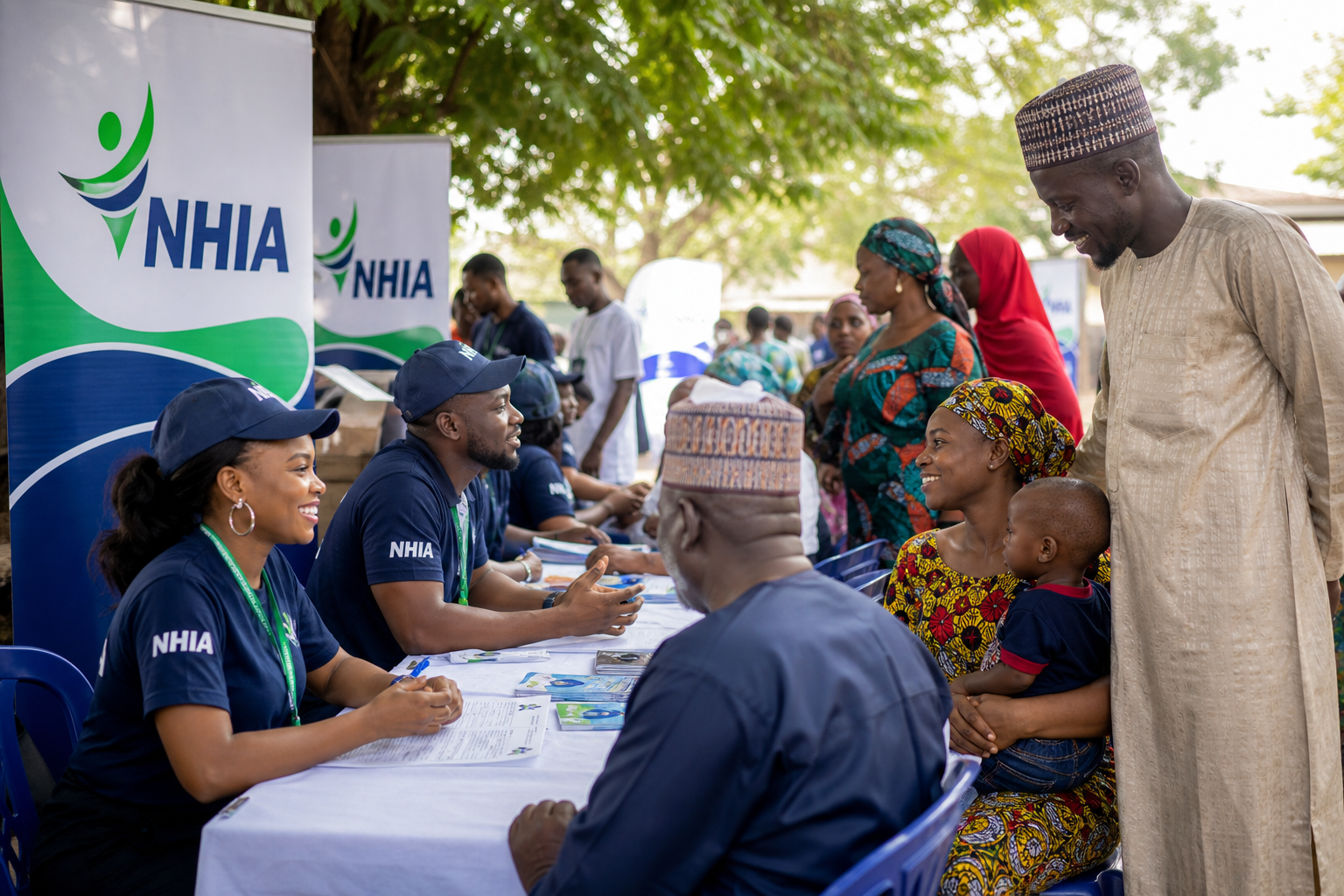
For self-employed Nigerians, informal-sector workers and families outside formal employment. You choose your HMO, your primary healthcare provider and whether to cover dependants. This is the main door in for most households.
State schemes (SSHIAs)
Run by your state’s own agency (LASHMA, OYSHIA, ASHIA, FHIS, etc.) under the NHIA Act. Contributions and benefits vary by state. Start here if you want a residence-based scheme rather than a federal one.
Vulnerable Group Fund (VGF)
For Nigerians who cannot afford premiums — the indigent, pregnant women, children under five, the elderly poor and persons with disabilities. Enrolment is free and funded through the VGF and Basic Health Care Provision Fund.
A quick note on the private sector: smaller businesses with fewer than five staff are not currently forced to enrol under OPSSHIP, but their workers can still get cover individually through GIFSHIP. Employers weighing their options can start with our guide to comparing health plans for businesses. And if you’ve enrolled already (or think you have), use the NHIA self-service portal walkthrough to check your record, pick up your e-ID and see which HMO and hospital you’re assigned to.
Gather these before you start
Getting these together first will save you time and avoid delays at activation.
Your NIN
The National Identification Number is required for GIFSHIP enrolees and underpins every NHIA record. Have your BVN handy too.
Passport photograph and personal details
Recent passport-style photo, plus your state and Local Government Area (LGA).
Dependant details
If you’re covering family. Cover typically extends to one spouse and up to four biological children under 18, with additional dependants often available at extra cost.
HMO and hospital choice
Pick an NHIA-accredited HMO and a Primary Healthcare Provider (HCP) near you. The portal shows the current accredited list.
How to enrol in the NHIA
Confirm which programme applies to you
Salaried at a company with five or more staff? Your employer handles it under OPSSHIP. Self-employed or covering your family? GIFSHIP through an HMO is your route. A resident wanting a state plan? Start with your State Social Health Insurance Agency — our state schemes explainer shows which agency to go to.
Choose an NHIA-accredited HMO
Only accredited HMOs satisfy the law and give you valid cover. Confirm accreditation before you pay anything, and use our checklist on what to look for when comparing HMO plans so you weigh hospital network and benefit limits, not just price.
Select your Primary Healthcare Provider
Pick a facility that is convenient for you and accredited under your chosen HMO. Under GIFSHIP you generally choose your own HMO and HCP. Under employer-led OPSSHIP, the employer may assign the HMO, so confirm which one you’re on and which hospitals it covers near you.
Gather your documents
Have your NIN, passport photograph, personal details, and dependant information ready in one place.
Submit your application
For OPSSHIP, the employer applies on behalf of staff and submits the documentation. For GIFSHIP, a group submits an application, usually covering ten or more people, listing each enrolee with their NIN. Enrolment structures vary by HMO and state implementation.
Pay your premium
Pay the agreed amount for your plan and dependants. Keep your payment reference — you’ll need it if reconciliation is delayed.
Get your confirmation
You’ll receive enrolment confirmation and, depending on the HMO, an enrolee ID or card. Check that your details and assigned facility are correct. You can also pull up your record on the NHIA self-service portal and save your e-ID there.
Activate and use your cover
Note any waiting period before certain benefits begin. When you need care, go to your assigned HCP first. For secondary or tertiary treatment, your HMO may need to issue a pre-authorisation code, so involve them early.
If you are still deciding between providers, our ranking of the top health insurance plans in Nigeria for 2026 compares hospital networks, premiums, and coverage limits side by side.
Compare NHIA-accredited HMO plans →Indicative premiums in 2026
Premiums vary by HMO, plan tier, group size, and how many dependants you add. The figures below are indicative 2026 ranges, not fixed national prices, so treat them as a guide and confirm the latest with your HMO.
| Route | Indicative 2026 cost | Notes |
|---|---|---|
| GIFSHIP individual (basic tier) | From ₦45,000 a year | Covers primary and common secondary care at your chosen hospital. |
| GIFSHIP family (principal + spouse + 4 children) | From ₦80,000–₦150,000 a year | Depending on HMO, hospital tier and benefit limits. |
| GIFSHIP higher tiers (wider network, higher limits) | ₦150,000–₦400,000+ | For broader hospital access and richer benefits. |
| Formal sector (OPSSHIP) | Shared employer and employee contribution | Typically 10% employer, 5% employee of basic salary, deducted at source. |
| State scheme (informal tier) | Low thousands to low tens of thousands | Rate set by your state agency; varies widely. |
| Vulnerable Group Fund | ₦0 | Enrolled free through VGF and BHCPF equity funding. |
To put that in context, an ₦80,000 annual plan works out to under ₦7,000 a month per person. That is often less than the cost of a single private hospital consultation, which is the case health insurance is built to make.
Prices have also climbed over the last two years, and many Nigerians quietly overpay for the cover they hold. It is worth checking whether you could save money by comparing HMOs before you renew or sign up.
What goes wrong, and how to avoid it
Paying a non-accredited HMO
If the HMO is not accredited by the NHIA, your cover may not be valid and you won’t meet the legal requirement. Always verify first on the NHIA site or portal.
Assuming everything is covered
Every plan has exclusions, benefit limits, and waiting periods. Read the benefit package before you pay, and ask specifically about maternity, dental, optical and chronic conditions.
Skipping pre-authorisation
For higher-level care, your HMO may need to approve treatment first. Not calling them early can delay or complicate a claim.
Details that don’t match
A NIN or name mismatch can hold up your activation. Check every field on your confirmation, and fix typos before you leave the enrolment desk.
If you earn a steady salary, the smartest move is to confirm exactly what your employer already provides before buying anything extra. Many staff are enrolled through OPSSHIP without realising it, so find out your HMO, your assigned hospital, and what your plan covers. The NHIA self-service portal is the fastest way to check. If your employer offers nothing, or you want wider cover for your family, a GIFSHIP plan can fill the gap.
If you’re self-employed or supporting a family, think in terms of the whole household, not just yourself. A plan that covers your spouse and children shields you from the single biggest financial shock most Nigerian families face — an unexpected hospital bill. Budget the annual premium the way you would school fees, as a fixed yearly cost that buys peace of mind. And if you’re deciding whether a private HMO plan would serve you better than the public route, our comparison of NHIA versus private HMO plans works through cost, coverage, network and waiting periods side by side.
Frequently asked questions
Is the NHIS still active in Nigeria?
No. The National Health Insurance Scheme was replaced by the National Health Insurance Authority under the NHIA Act 2022. People still say “NHIS” out of habit, but the correct body today is the NHIA.
What is the difference between the NHIS and the NHIA?
The NHIS was a mostly voluntary scheme with low coverage. The NHIA is a regulatory authority, and enrolment is now mandatory for all Nigerians. The NHIA also accredits HMOs and funds cover for vulnerable groups. Our pillar on the NHIA Act 2022 explains the full legal shift.
Is health insurance compulsory in Nigeria now?
Yes, the NHIA Act 2022 makes health insurance mandatory for all Nigerians. In practice, enforcement is still growing, but the legal requirement is in place, including for private businesses with five or more staff.
Can I enrol as a self-employed individual?
Yes. The GIFSHIP programme is designed for people outside formal employment, including the self-employed and informal workers. You enrol through an NHIA-accredited HMO, and you’ll need your NIN.
What does cover include for my family?
Cover typically extends to one spouse and up to four biological children under 18. Additional dependants can often be added for an extra premium. Confirm the exact benefit package with your chosen HMO.
How do I know if an HMO is accredited?
Only use HMOs accredited by the NHIA. You can verify an HMO’s accreditation status on the NHIA self-service portal before you pay, and confirm which hospitals it covers in your area.
Compare NHIA-accredited HMO plans
Browse current plans on nairaCompare — premiums, hospital networks and benefits from NHIA-accredited providers, side by side.
The bottom line
The shift from the NHIS to the NHIA is more than a name change. It moves Nigeria towards health cover for everyone, backed by a stronger regulator and a clearer set of programmes for salaried workers, the self-employed, families, and vulnerable groups. Enrolling is now a practical step you can take in an afternoon, once you know your route and have your NIN ready.
The best decision is an informed one. Before you commit to an HMO, use the NHIA self-service portal walkthrough to check your existing status, read the pillar on the NHIA Act 2022 for the legal framework, compare state schemes in our state schemes explainer, and weigh public versus private routes in our NHIA versus private HMO comparison.
Disclaimer: Premiums, benefit packages, waiting periods, exclusions and enrolment rules differ by HMO and plan and change over time. Verify all details, including exclusions, waiting periods, and covered facilities, with the HMO and the NHIA before enrolling. This article provides general information and is not personal medical, legal or financial advice.
About Author
Noella Lepdung
Noella Lepdung, LL.B, is a strategist and writer specialising in financial services, SEO, and digital content. With a background in brand storytelling and organic growth, she creates research-driven content that makes complex topics accessible, engaging, and useful to readers. Her experience spans financial services, healthcare, and consumer brands, and her portfolio includes work for brands such as nairaCompare, Monieworx, Leadway Group, Budweiser, The Coca-Cola Company, Nivea, and Honeywell Foods.


Other related articles