


.png?width=40&height=40&name=Rectangle%202052%20(2).png)
.png?width=40&height=40&name=Rectangle%202052%20(1).png)






.jpg?width=1200&height=628&name=Your%20Complete%20Guide%20to%20Comparing%20Health%20Insurance%20Plans%20for%20Businesses%20in%20Nigeria%20(2026%20Edition).jpg)
.png?width=1266&height=427&name=blog%20header%20(27).png)
.webp?width=1266&height=427&name=blog%20header%20(38).webp)
%20(1).jpg?width=1200&height=628&name=Complete%20Guide_%20Sending%20Money%20from%20UK%20to%20Nigeria%20(2026)%20(1).jpg)


.webp?width=1200&height=628&name=Health%20Insurance%20Cost%20Report%20(2026).webp)

.png?width=1266&height=427&name=blog%20header%20(19).png)
.png?width=1266&height=427&name=blog%20header%20(30).png)
.png)
Author Noella Lepdung
Introduction
Your credit score determines whether you get approved for loans, the interest rates you pay, and even your ability to rent apartments or secure certain jobs in Nigeria. Yet most Nigerians have never checked their credit score, often assuming it costs money or requires complicated processes. The truth is simpler: you can check your credit score for free in Nigeria, understand what it means, and take steps to improve it without spending a kobo.
This guide explains what a credit score is, why it matters, how to check your credit score in Nigeria for free, and what actions to take based on your results. Whether you're planning to apply for a loan, want to understand your creditworthiness, or simply need to know where you stand financially, this step-by-step guide covers everything you need.
Table of Contents
- What is a Credit Score & Why It Matters
- What You'll Need
- How to Check Your Credit Score for Free
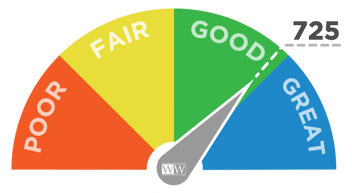
- Understanding Your Credit Score Range
- Common Mistakes to Avoid
- nairaCompare Insight
- FAQs
- Related Resources
- Conclusion
What is a Credit Score & Why It Matters
A credit score is a three-digit number (ranging from 300 to 850 in Nigeria) that represents your creditworthiness based on your borrowing and repayment history. Credit bureaus like CRC Credit Bureau calculate this score using your payment history, outstanding debts, credit utilization, length of credit history, and types of credit accounts.
Understanding the meaning of your credit score helps you grasp how lenders, landlords, and employers evaluate your financial reliability. A good credit score (typically 650 and above) signals that you pay debts on time and manage credit responsibly. A poor credit score (below 550) suggests payment difficulties or excessive borrowing, making lenders hesitant to approve your applications or forcing them to charge higher interest rates to offset perceived risk.
Your credit score directly impacts your loan approval chances and the interest rates you pay. Nigerian lenders check credit scores before approving personal loans, business loans, mortgages, and even salary advance requests. Someone with an excellent credit score might qualify for a ₦5 million loan at 18% annual interest, whilst someone with a poor score gets rejected or offered ₦2 million at 28% interest for the same income level.
Checking your credit score regularly helps you catch errors before they damage your financial prospects. Credit reports sometimes contain mistakes: loans marked as defaulted when you paid on time, accounts belonging to someone else with similar names, or outdated information not removed after dispute resolution. Discovering these errors early through free credit score checks allows you to dispute them with credit bureaus and lenders, correcting your record before applying for important loans.
Monitoring your credit score also protects against identity theft. If someone fraudulently opens accounts in your name, regular credit checks reveal these unauthorized activities early. You can then report the fraud to credit bureaus, freeze your credit file, and prevent further damage to your financial reputation.
What You'll Need
Before checking your credit score in Nigeria, gather the following information to ensure smooth processing:
Personal Identification: Your Bank Verification Number (BVN) serves as primary identifier linking your credit history across all financial institutions. Every credit bureau uses BVN to retrieve your credit information, so you cannot check your credit score without it. If you don't have a BVN, visit any Nigerian bank with valid ID (National ID, International Passport, Driver's Licence, or Voter's Card) to register. The BVN registration process takes about 10 minutes and is free at all Nigerian banks.
Contact Information: Provide accurate phone number and email address for verification and receiving your credit score results. Credit bureaus send one-time passwords (OTPs) to your phone and email credit reports to the address you provide. Using outdated contact information delays or prevents credit score access. Ensure your phone number and email are active and accessible during the checking process.
Basic Details: Prepare your full legal name (exactly as it appears on your BVN registration), date of birth, and current residential address. Mismatches between the information you provide and what credit bureaus have on file can block credit score retrieval or flag your request for manual review, adding days to what should be an instant process.
How to Check Your Credit Score for Free
Nigerian regulations require that you receive one free credit score check annually from each licensed credit bureau. However, navigating individual bureau websites and understanding their reports can prove confusing for first-time users. nairaCompare simplifies this process, offering free credit score checks with clear explanations of what your score means and actionable steps to improve it.
nairaCompare provides the easiest way to check your credit score in Nigeria, combining free access with educational resources helping you understand and improve your creditworthiness. The platform partners with licensed credit bureaus to deliver accurate, instant credit scores whilst explaining what factors affect your rating.

Step 1: Visit nairaCompare Credit Score Page
Navigate to nairacompare.ng/credit-score using any device (smartphone, tablet, or computer). The page displays clear information about credit scores, what they mean, and how nairaCompare's free credit checker works. Unlike confusing bureau websites requiring navigation through multiple pages, nairaCompare presents everything on one straightforward interface designed for Nigerian users.
Step 2: Select Your Credit Checker Package
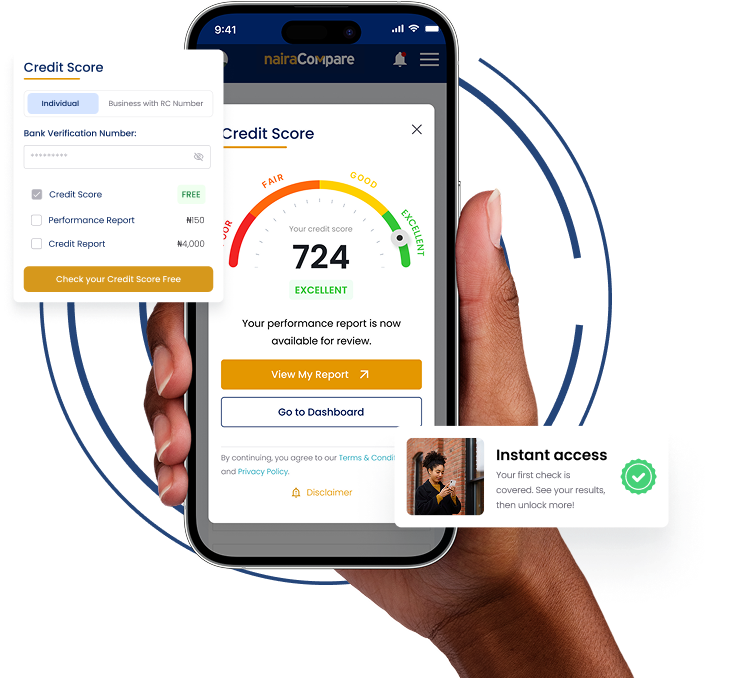
nairaCompare offers three credit checker packages tailored to different needs: basic credit score (1 free check per year), comprehensive credit report (₦4,000), and performance report tracking progress over time (₦150). For your free annual check, select the basic credit score option.
The free credit score package provides everything most Nigerians need: instant score viewing (300-850 range), score classification (Excellent, Good, Fair, Poor), and guidance on what actions to take based on your results. After using your one free check, additional basic checks cost ₦700, significantly less than purchasing directly from credit bureaus which often charge ₦1,000-₦2,000 per report.
If you need more detailed information, the ₦4,000 comprehensive credit report includes your full credit history showing all accounts, payment patterns, outstanding debts, credit inquiries from lenders, and public records like court judgments. The ₦150 performance report helps you track improvements over time, perfect for monitoring credit score changes as you implement improvement strategies.
Step 3: Provide Your BVN and Personal Details
Enter your 11-digit Bank Verification Number exactly as registered with your bank. Double-check each digit to avoid errors that delay score retrieval. Provide your full name, date of birth, phone number, and email address matching your BVN registration details. Any mismatch between what you enter and what appears in the credit bureau database will trigger verification delays or rejections.
nairaCompare encrypts all personal information using bank-level security standards meeting international data protection requirements. Your BVN and credit data remain confidential, used only to retrieve your credit score from licensed bureaus. The platform never shares your information with third parties without explicit consent, and all data transmission occurs through secure, encrypted channels.
Step 4: Verify Your Identity
nairaCompare sends a one-time password (OTP) to your registered phone number to confirm your identity. Enter this OTP within the specified timeframe (usually 5-10 minutes) to proceed. This verification step prevents unauthorized credit checks, protecting you from identity theft whilst ensuring you're accessing your own credit information rather than someone else's.
If you don't receive the OTP within 2-3 minutes, check that your phone has network coverage and hasn't blocked messages from unknown senders. Request a new OTP if the first doesn't arrive, and ensure you're entering the code exactly as received without adding spaces or extra characters.
Step 5: Receive and Review Your Credit Score
Within seconds of verification, nairaCompare displays your credit score on screen. The score appears as a number between 300 and 850, accompanied by classification (Excellent, Good, Fair, or Poor) and brief explanation of what your score means for loan applications, interest rates, and financial opportunities.
nairaCompare's interface explains your score in plain language, avoiding the confusing bureau jargon that leaves many Nigerians uncertain about what their scores actually mean. If your score falls below expectations, the platform suggests specific actions to improve it: paying outstanding debts, reducing credit card balances, disputing errors, or diversifying your credit mix.
Step 6: Understand Your Results and Take Action
Review nairaCompare's personalized recommendations based on your credit score range. Excellent scores (750-850) qualify you for best loan rates and terms; maintain this standing by continuing timely payments and low credit utilization. Good scores (650-749) provide solid borrowing access; improve further by lengthening credit history and reducing outstanding balances.
Fair scores (550-649) limit loan options and increase interest costs; focus on clearing delinquent accounts, disputing errors, and establishing consistent payment patterns. Poor scores (below 550) block most formal lending; prioritize settling defaults, negotiating payment plans with creditors, and rebuilding credit through secured products like savings-backed loans.
Alternative Methods to Check Your Credit Score
Check Directly Through CRC Credit Bureau: CRC Credit Bureau, one of Nigeria's licensed credit reporting agencies, offers direct credit score access through their website. Visit their portal, create an account using your BVN, complete identity verification through OTP, and request your credit score. CRC provides one free report annually as mandated by regulation.
Request from Your Bank: Some Nigerian banks provide credit scores to customers as value-added service. Check your bank's mobile app or internet banking platform for credit score features, often found under "Loans" or "Credit" sections. However, not all banks offer this service, and those that do may charge fees or limit frequency of checks.
FirstCentral Credit Bureau: FirstCentral operates as another licensed credit reporting agency. Visit their website, register using your BVN, verify identity, and request your credit score. They provide one free credit report annually with paid options for additional checks.
Understanding Your Credit Score Range
Nigerian credit scores range from 300 (worst possible) to 850 (best possible), with most active borrowers falling between 500 and 750. Understanding what each range means helps you interpret your results and take appropriate action.
Excellent (750-850): Exceptional credit management demonstrating consistent on-time payments, low credit utilization (using less than 30% of available credit), lengthy credit history, and diverse credit mix. Lenders view you as minimal risk, offering best interest rates (often 3-5 percentage points below standard rates), highest loan amounts, fastest approvals, and premium financial products. Maintain this score by continuing responsible credit behaviour and monitoring for errors that could damage your standing.
Good (650-749): Solid creditworthiness with mostly timely payments, moderate debt levels, and reasonable credit history. You qualify for most loans and credit cards at competitive interest rates, though not the absolute best terms reserved for excellent scores. Improve by reducing credit card balances below 30% utilization, avoiding new credit inquiries, and ensuring all payments post on time. One or two minor late payments (under 30 days past due) or slightly high utilization likely holds you in this range rather than excellent.
Fair (550-649): Acceptable credit with some red flags like occasional late payments (30-60 days past due), higher debt-to-income ratios, or limited credit history. Lenders approve you selectively, often requiring higher interest rates (4-8 percentage points above prime), larger down payments, or co-signers to offset perceived risk. Focus improvement efforts on clearing any delinquent accounts, disputing errors on your report, and establishing 6-12 months of perfect payment history to graduate into good territory.
Poor (Below 550): Significant credit problems including defaults, charge-offs, collections, or very recent serious delinquencies (90+ days past due). Most traditional lenders reject applications, forcing you toward high-cost alternatives like digital lenders charging 20-35% monthly interest or informal sources. Rebuilding requires settling outstanding defaults, negotiating payment plans with creditors showing genuine commitment to repayment, and potentially starting fresh with secured credit products where your deposit serves as collateral. Recovery takes time but remains possible with disciplined financial behaviour and patience.
Common Mistakes to Avoid
Ignoring Your Credit Score Until You Need a Loan: Most Nigerians only check credit scores when lenders reject applications, discovering problems too late to fix before important borrowing needs. Check your credit score at least annually, preferably semi-annually, to catch errors early and monitor improvement from positive financial behaviours. Use your free nairaCompare check strategically, reviewing your score 2-3 months before major financial decisions like applying for mortgages or car loans, giving you time to address issues.
Not Disputing Errors on Credit Reports: Credit reports frequently contain mistakes: loans you never took appearing on your file, payments incorrectly marked as late despite on-time payment, or old accounts that should have been removed after seven years. Accepting these errors damages your score unnecessarily. If you spot inaccuracies, dispute them immediately with both the credit bureau and the reporting institution, providing documentation supporting your claim like bank statements showing on-time payments or loan closure letters.
Checking Credit Score Too Frequently Through Hard Inquiries: Each loan application triggers "hard inquiry" on your credit report, temporarily lowering your score by 2-5 points. Multiple hard inquiries within short periods signal financial desperation, further damaging your creditworthiness and making lenders question why you're applying everywhere. Checking your own score through nairaCompare or credit bureaus counts as "soft inquiry" that doesn't affect your score, so monitor freely without concern. However, avoid applying for multiple loans simultaneously just to "test chances" with different lenders.
Closing Old Credit Accounts: Length of credit history contributes 15% of your credit score calculation. Closing your oldest credit card or loan account shortens average account age, potentially lowering your score even if you maintain perfect payment behaviour on remaining accounts. Unless the account charges annual fees you cannot afford or tempts overspending you can't control, keep old accounts open even if unused. Occasional small purchases (₦500-₦1,000 monthly) paid in full maintain account activity without accumulating debt.
Ignoring Small Debts: A ₦5,000 unpaid loan damages your credit score just as severely as a ₦500,000 default. Credit bureaus report all delinquencies regardless of amount, and lenders view pattern of small unpaid debts as indicator of poor financial management and lack of integrity. Settle all outstanding obligations, even minor amounts like ₦2,000 or ₦3,000, and establish payment plans for debts you cannot clear immediately, demonstrating commitment to honouring obligations.
Assuming No Credit Score Means Good Credit: Having no credit score (because you've never borrowed) differs fundamentally from having good credit. Lenders prefer established credit history demonstrating responsible borrowing over complete absence of credit activity. If you've never taken loans, consider starting with low-risk products like secured credit cards (where you deposit ₦50,000-₦100,000 as collateral), small personal loans you can easily repay (₦20,000-₦50,000 over 3-6 months), or buy-now-pay-later services for purchases you'd make anyway, building positive credit history gradually without taking unnecessary financial risk.

nairaCompare Insight
For first-time credit score checkers, don't panic if your initial score falls below expectations. Many Nigerians discover fair or poor scores simply because they never knew late payments damaged long-term creditworthiness or that ₦10,000 debts from 2019 still appear on reports. The positive news is that credit scores respond to improved behaviour relatively quickly compared to other financial metrics.
Six months of consistent on-time payments can raise fair scores into good territory, whilst settling defaults and disputing verified errors produces even faster improvements, sometimes boosting scores 50-100 points within 90 days. Focus on what you can control immediately: pay all current obligations on time (even minimum payments if that's all you can afford), reduce credit card balances below 30% of limits, and dispute any errors found on your credit report through formal written disputes to credit bureaus.
These actions cost nothing but deliver measurable score improvements within 3-6 months. Use nairaCompare's free credit score check to establish your baseline, understanding where you currently stand. Then monitor progress using the affordable ₦150 performance report tracking changes over time, helping you see which actions produce the biggest improvements and maintaining motivation as your score climbs from poor to fair to good to excellent over 12-24 months of disciplined financial management.
Frequently Asked Questions
1. How can I check my credit score for free in Nigeria?
Visit nairacompare.ng/credit-score, click "Check My Credit Score," enter your BVN and personal details, verify your identity through OTP, and receive instant results. The entire process takes under 5 minutes and requires only your Bank Verification Number and basic personal information.
2. How do I check my credit score in Nigeria?
The easiest method is through nairaCompare's free credit checker at nairacompare.ng/credit-score. Alternatively, check directly through licensed credit bureaus (CRC, FirstCentral) or some Nigerian banks offering credit scores through mobile banking apps.
3. What is a good credit score in Nigeria?
Credit scores range from 300-850. Excellent scores fall between 750-850, good scores 650-749, fair scores 550-649, and poor scores below 550. Scores above 650 generally qualify you for competitive loan rates and favourable terms from most Nigerian lenders.
4. How often should I check my credit score?
Check your credit score at least once annually using free options, and semi-annually if actively managing credit or planning major borrowing. Monitor more frequently (quarterly or monthly using ₦150 performance reports) if rebuilding credit after defaults or disputing errors, allowing you to track improvement from positive actions.
5. Does checking my own credit score lower it?
No, checking your own credit score through nairaCompare or credit bureaus counts as "soft inquiry" that doesn't affect your score. Only "hard inquiries" from loan applications temporarily lower scores by 2-5 points. Monitor your credit freely without concern about damaging your rating.
6. What is the meaning of credit score?
A credit score is a numerical representation (300-850) of your creditworthiness based on borrowing and repayment history. It helps lenders, landlords, and employers evaluate your financial reliability, determining loan approval chances, interest rates offered, and terms provided.
7. Can I improve a poor credit score?
Yes, poor credit scores improve through consistent positive financial behaviour. Pay all debts on time for 6-12 months, reduce credit card balances below 30% of limits, settle outstanding defaults through payment plans or lump-sum settlements, dispute report errors with documentation, and avoid new hard inquiries. Significant improvement typically takes 6-18 months depending on damage severity and consistency of positive actions.
8. What if I find errors on my credit report?
Dispute errors immediately with both the credit bureau (CRC, FirstCentral) and the institution that reported incorrect information. Provide documentation supporting your claim such as bank statements showing on-time payment, loan closure letters, or court judgments in your favour. Bureaus must investigate within 30 days and correct verified errors, removing inaccurate information that damages your score.
9. Why do I have no credit score?
You have no credit score if you've never borrowed from institutions reporting to credit bureaus. To establish credit, take a small personal loan (₦20,000-₦50,000), apply for a secured credit card backed by savings deposit, or make buy-now-pay-later purchases you can easily repay, making on-time payments to build positive history over 6-12 months.
10. How long do negative items stay on credit reports?
Most negative information remains on credit reports for 7 years from the date of first delinquency, including late payments, defaults, charge-offs, and collections. Court judgments, tax liens, and bankruptcies may remain up to 10 years. Positive information typically stays indefinitely, helping your score long-term as evidence of responsible credit management.
Conclusion
Checking your credit score for free in Nigeria has never been easier, with nairaCompare offering instant access, clear explanations, and actionable improvement strategies all in one platform. Your credit score affects nearly every major financial decision you make, from loan approvals and interest rates to rental applications and employment opportunities in sensitive sectors.
Don't wait until lenders reject your application to discover credit problems that could have been addressed months earlier. Take control of your financial reputation today by checking your credit score, understanding what it means for your borrowing prospects, and taking concrete steps to improve or maintain it based on personalized recommendations.
Check your credit score for free on nairaCompare now and start building the financial future you deserve!
Credit score information reflects data reported to credit bureaus by financial institutions and may not capture all financial activities. Scores vary between bureaus due to different scoring models and data sources. Checking your own credit score doesn't affect your rating, but loan applications create hard inquiries that temporarily lower scores. Credit score improvement requires consistent positive financial be

Noella Lepdung
Noëlla Lepdung is a writer who makes magic with all sorts of content, helping businesses find their voice and meet their ambitions with cutting-edge but human-first advertising. Her portfolio features brands such as Budweiser, The Coca-Cola Company, Nivea, Leadway Group, Honeywell Foods, Monieworx, Kimberly-Clark, and WAMCO.


Other related articles