


.png?width=40&height=40&name=Rectangle%202052%20(2).png)
.png?width=40&height=40&name=Rectangle%202052%20(1).png)




-3.jpg?width=1200&height=628&name=Top%2010%20Health%20Insurance%20Plans%20in%20Nigeria%20in%202026%20(Affordable%20%26%20Reliable%20Options)-3.jpg)
%202.jpg?width=1200&height=628&name=Top%2010%20Health%20Insurance%20Plans%20in%20Nigeria%20in%202026%20(Affordable%20%26%20Reliable%20Options)%202.jpg)

.jpg?width=1200&height=628&name=Best%20Car%20Loans%20in%20Nigeria%20(2026%20Ranking).jpg)


.jpg?width=1200&height=628&name=Your%20Complete%20Guide%20to%20Comparing%20Health%20Insurance%20Plans%20for%20Businesses%20in%20Nigeria%20(2026%20Edition).jpg)
.png?width=1266&height=427&name=blog%20header%20(27).png)
.webp?width=1266&height=427&name=blog%20header%20(38).webp)
%20(1).jpg?width=1200&height=628&name=Complete%20Guide_%20Sending%20Money%20from%20UK%20to%20Nigeria%20(2026)%20(1).jpg)


.png?width=1266&height=427&name=blog%20header%20(19).png)
.png?width=1266&height=427&name=blog%20header%20(30).png)
.webp?width=1200&height=628&name=Health%20Insurance%20Cost%20Report%20(2026).webp)

Author Noella Lepdung
Introduction
Personal loans have become a financial lifeline for millions of Nigerians navigating an economy marked by inflation, naira devaluation, and rising living costs. Whether you're a salary earner facing unexpected medical bills, a business owner needing inventory capital, or a young professional planning a major purchase, understanding how personal loans work in Nigeria can mean the difference between smart borrowing and a debt trap that strains your finances for months.
This comprehensive guide walks you through everything you need to know about personal loans in Nigeria in 2026. From understanding interest rates and choosing between digital lenders and traditional banks, to building your credit profile and avoiding predatory practices, you'll learn how to access credit responsibly, compare options effectively, and use loans as tools for financial progress rather than burdens that hold you back.

Table of Contents:
- What is a Personal Loan & Why It Matters
- How Personal Loans Work in Nigeria
- Types of Personal Loans Available
- Cost Breakdown: Fees, Rates & Hidden Charges
- How to Get Started: Step-by-Step Application Process
- Benefits of Personal Loans
- Risks & Common Mistakes to Avoid
- How to Choose the Right Personal Loan
- Regulatory Framework: CBN & FCCPC Guidelines
- nairaCompare Insight
- FAQs
- Related Resources
What is a Personal Loan & Why It Matters
A personal loan is borrowed from a financial institution that you repay over time with interest. Unlike mortgages tied to property or car loans secured by vehicles, personal loans in Nigeria are typically unsecured, meaning you don't need to provide collateral like land titles or guarantors. You receive a lump sum upfront and repay in fixed instalments over an agreed period, usually ranging from 30 days to 24 months.
Personal loans matter because they provide immediate access to capital when you need it most. In Nigeria's cash-based economy where salaries often arrive late and unexpected expenses are common, personal loans bridge financial gaps that could otherwise derail your plans or force you into more expensive alternatives like informal moneylenders charging exploitative rates.
The personal loan industry in Nigeria has transformed dramatically since 2020. Digital lending platforms now disburse over ₦100 billion monthly to millions of borrowers, making credit accessible to people previously excluded from traditional banking. As of early 2026, there are over 400 fully approved digital lending platforms registered with the FCCPC, with additional lenders under conditional approval or watchlist status, creating unprecedented choice but also requiring borrowers to understand how to navigate this expanded landscape.
How Personal Loans Work in Nigeria
Personal loans follow a straightforward process, but understanding each part helps you borrow smarter and avoid common pitfalls.
Core Process in 5 Steps
Step 1: Application
You apply through a mobile app, website, or bank branch. Digital lenders typically require your phone number, BVN (Bank Verification Number), valid ID, and bank account details. Some digital lenders use alternative data such as smartphone usage and bank transaction history for initial credit assessment. Traditional banks require employment letters, pay slips, and bank statements.
Step 2: Credit Assessment
The lender evaluates your creditworthiness using various data points. Digital lenders analyse phone usage patterns, transaction history via Remita, social media behaviour, or previous loan repayment records. Banks examine employment stability, income levels, and existing debt obligations. This assessment determines if you qualify, how much you can borrow, and what interest rate you'll pay.
Step 3: Loan Offer
If approved, you receive a loan offer specifying the amount, interest rate, repayment period, and total cost. Read this carefully. The offer shows your monthly instalment, any processing fees (typically 3-15%), and the total amount you'll repay. Digital lenders display this in-app. Banks provide formal letters. You're not obligated to accept, never feel pressured.
Step 4: Disbursement
After accepting terms, funds transfer to your bank account. Digital platforms like FairMoney and Branch disburse within 5 minutes to 24 hours. Traditional banks take 2-7 days depending on approval complexity. Some platforms like Carbon credit your in-app wallet instantly, then you transfer to your bank account.
Step 5: Repayment
You repay via direct debit, bank transfer, or in-app payment. Most lenders use the Global Standing Instruction (GSI) system allowing automatic deduction from any of your bank accounts on due dates. This prevents missed payments but requires maintaining sufficient balance. Some platforms offer manual payment options through bank transfers or USSD codes.

Key Components
Principal Amount: The actual money you borrow, ranging from ₦2,000 to ₦6,000,000 depending on the lender and your profile.
Interest Rate: The cost of borrowing, expressed as monthly percentage. A 5% monthly rate on ₦100,000 costs ₦5,000 per month. Personal loan interest rates in Nigeria vary widely by lender and borrower profile, with some digital lenders charging higher monthly percentages depending on risk.
Processing Fee: Upfront charge for loan origination, typically 3-15% of loan amount. A ₦200,000 loan with 10% processing fee costs ₦20,000, meaning you receive ₦180,000 but repay based on ₦200,000.
Repayment Period: Duration for repaying the loan, from 30 days to 24 months. Shorter periods mean higher monthly instalments but lower total interest. Longer periods reduce monthly burden but increase total cost.
Total Repayment Amount: Principal plus all interest and fees. A ₦100,000 loan at 10% monthly for 3 months costs ₦30,000 interest plus potential processing fees, totalling ₦130,000+ repayment.
Use Tables for Comparison
|
Loan Amount |
Interest Rate |
Period |
Monthly Payment |
Total Repayment |
Total Interest |
|
₦100,000 |
5% monthly |
3 months |
₦35,000 |
₦105,000 |
₦5,000 |
|
₦100,000 |
10% monthly |
3 months |
₦43,333 |
₦130,000 |
₦30,000 |
|
₦500,000 |
3% monthly |
6 months |
₦91,667 |
₦550,000 |
₦50,000 |
|
₦1,000,000 |
4% monthly |
12 months |
₦123,333 |
₦1,480,000 |
₦480,000 |
Types of Personal Loans Available
Personal loans in Nigeria come in several categories, each designed for specific needs and borrower profiles.
Payday Loans
Short-term loans meant to bridge the gap until your next salary. Typically, ₦10,000 to ₦100,000 for 14 to 30 days. These carry higher interest rates (10-20% monthly) due to short tenure but solve immediate cash flow problems. Platforms like Palmcredit and Migo specialize in payday loans. Use only when you're certain your next salary can cover repayment, as rollovers accumulate expensive fees.
Salary Advance Loans
Loans tied to your employment, where your employer may take part in repayment. Amounts range from ₦50,000 to ₦500,000 with 1 to 6 month terms. Lenders like Renmoney and Specta offer these, often requiring employment letters. Interest rates are more competitive (4-8% monthly) because employment verification reduces default risk. Some employers partner with specific lenders to offer staff preferential rates.
Consumer Loans
General-purpose loans for any personal use from home appliances to travel. These range from ₦100,000 to ₦3,000,000 with 3 to 24 month repayment periods. Interest rates vary widely (3-15% monthly) based on amount, tenure, and creditworthiness. FairMoney and Carbon excel here. Use consumer loans for planned expenses where you can calculate exact repayment capacity.
Emergency Loans
Quick-approval loans for urgent, unforeseen expenses like medical emergencies or urgent repairs. Amounts typically ₦20,000 to ₦500,000 disbursed within hours. These may carry slightly higher rates (8-15% monthly) due to urgency and minimal vetting. Branch and Carbon provide emergency loans. Keep repayment realistic despite urgency, debt doesn't solve problems if you can't repay.
Business Loans (Personal)
While technically business financing, many entrepreneurs access these as personal borrowers. Amounts from ₦100,000 to ₦5,000,000 for inventory, equipment, or working capital. Tenures run 3 to 18 months with rates around 3-8% monthly. FairMoney offers business loans up to ₦5 million. These require proving business income through bank statements or revenue records.
Top-Up Loans
Additional loans offered to existing customers with good repayment history. If you borrowed ₦100,000 and repaid successfully, your lender may offer ₦200,000 before your original loan is fully cleared. Top-ups often come with better rates (2-5% lower than initial rate) and higher amounts. This is how platforms reward loyalty, use it strategically for planned needs, not impulsive borrowing.
Comparison Table
|
Loan Type |
Typical Amount |
Tenure |
Interest Rate |
Best For |
|
Payday |
₦10,000 - ₦100,000 |
14-30 days |
10-20% monthly |
Salary gap bridging |
|
Salary Advance |
₦50,000 - ₦500,000 |
1-6 months |
4-8% monthly |
Employed individuals |
|
Consumer |
₦100,000 - ₦3,000,000 |
3-24 months |
3-15% monthly |
Planned purchases |
|
Emergency |
₦20,000 - ₦500,000 |
1-6 months |
8-15% monthly |
Urgent needs |
|
Business |
₦100,000 - ₦5,000,000 |
3-18 months |
3-8% monthly |
Business owners |
|
Top-Up |
Varies |
Flexible |
2-10% monthly |
Loyal customers |
Understanding Your Credit Score Matters
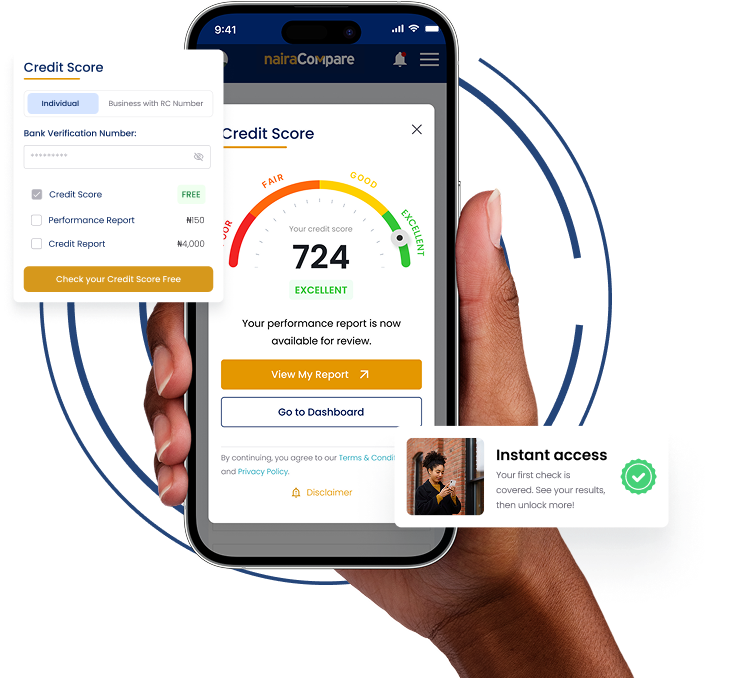
Every loan you've taken, every payment you've made (or missed), and every debt you carry contributes to your credit score—a number between 300 and 850 that lenders use to decide whether to approve your applications. Landlords check it before renting apartments, employers review it during background checks, and banks use it to set your interest rates. Yet most Nigerians have never seen their own number.
Take control of your financial reputation with nairaCompare's free credit checker. Get instant access to your credit score, learn what it means in plain language, and discover exactly what steps to take to improve it. One free check annually, with affordable options to track your progress over time.

Cost Breakdown: Fees, Rates & Hidden Charges
Understanding the true cost of borrowing prevents unpleasant surprises and helps you compare lenders accurately.
Interest Rates Explained
Interest rates represent the cost of borrowing money. In Nigeria, personal loan rates are typically quoted monthly rather than annually. A 5% monthly rate means you pay 5% of the principal each month until repayment is complete.
Monthly vs. Annual Rates:
- 5% monthly = approximately 60% annual (simple calculation)
- With compounding and fees, effective APR often reaches 80-120%
- Always ask for both monthly rate and APR for accurate comparison
Rate Ranges by Lender Type:
- Digital lenders: 3% to 30% monthly depending on credit profile
- Microfinance banks: 2.5% to 15% monthly
- Commercial banks: 2% to 8% monthly (when available)
- Informal lenders: Often exceed 30% monthly (avoid these)
Processing Fees
Most lenders charge upfront processing fees for loan origination. These range from 3% to 15% of the loan amount and are typically deducted before disbursement.
Example: You apply for ₦200,000 with 10% processing fee.
- Processing fee: ₦20,000
- Amount disbursed: ₦180,000
- Amount you repay: ₦200,000 + interest
This effectively increases your borrowing costs. A platform offering 8% monthly interest plus 10% processing fee is more expensive than one offering 10% monthly with no processing fee for short-term loans.
Hidden Charges to Watch
Late Payment Penalties: Typically, 0.1% to 0.5% daily on outstanding balance. Missing a ₦100,000 payment by 10 days at 0.3% daily costs ₦3,000 extra.
Early Repayment Fees: Some lenders charge 2-5% of remaining principal if you repay early, reducing their expected interest income. Check this before borrowing if you expect early repayment.
SMS/Alert Charges: Some platforms charge ₦10-₦50 per payment reminder or transaction alert. These accumulate over 6-12 month loans.
Insurance Fees: Optional or mandatory insurance (life, loan protection) adds 1-3% to loan cost. Read fine print on whether this is optional.
Restructuring Fees: If you negotiate extended repayment due to financial difficulty, some lenders charge 5-10% of outstanding balance as restructuring fee.
Cost Drivers
Several factors determine your personal loan cost:
Creditworthiness: First-time borrowers pay 10-15% monthly while established customers with perfect repayment history access 3-5% monthly rates from the same lender.
Loan Amount: Larger loans (₦1 million+) often get better rates (3-5% monthly) while small loans (under ₦50,000) face higher rates (10-15% monthly) due to fixed processing costs.
Repayment Period: Shorter tenures typically offer lower monthly rates. A 3-month loan might be 5% monthly while 12-month tenure for the same amount could be 8% monthly.
Lender Type: CBN-licensed microfinance banks like Renmoney and FairMoney offer 2.5-8% monthly. Pure digital lenders range 5-15% monthly. Commercial banks (when available) offer 2-5% monthly but with stricter requirements.
Documentation Provided: Borrowers who provide employment letters, pay slips, and bank statements access better rates than those using only phone data or basic identification.
How to Get Started: Step-by-Step Application Process
Applying for a personal loan in Nigeria involves clear steps. Following this process systematically increases approval chances and ensures you understand terms before committing.
Step 1: Assess Your Need
Before applying, determine exactly how much you need and why. Borrowing ₦500,000 when ₦300,000 suffices costs you unnecessary interest. Create a specific breakdown of expenses and add only a small buffer (10-15%) for contingencies.
Step 2: Check Your Eligibility
Most Nigerian lenders require:
- Age 18-60 years
- Nigerian citizenship or residency
- Bank account with Nigerian bank
- BVN (Bank Verification Number)
- Valid identification (NIN, driver's license, international passport, voter's card)
- Verifiable income source (employment, business, freelancing)
Additional requirements vary by lender and amount. Larger loans (₦500,000+) typically need employment letters or business documentation.
Step 3: Choose Your Lender
Compare at least 3-5 lenders focusing on:
- Interest rates for your credit profile
- Maximum loan amounts available
- Processing fees and other charges
- Disbursement speed
- Repayment flexibility
- Customer reviews and complaint handling
- FCCPC approval status
Use nairaCompare's loan comparison tool to see rates side-by-side.
Step 4: Gather Required Documents
Standard documents include:
- Valid ID card (government-issued)
- BVN
- Bank account details
- Proof of address (utility bill, rent receipt)
- Employment letter or business registration (for larger amounts)
- Recent pay slips or bank statements (3-6 months)
Digital lenders need fewer documents than traditional banks. Some platforms like Branch require only your phone and NIN for initial loans under ₦10,000.
Step 5: Submit Application
For Digital Lenders:
- Download app from official store (Google Play, Apple App Store)
- Register with phone number and email
- Complete KYC (Know Your Customer) verification
- Enter loan amount and preferred tenure
- Upload required documents or grant permissions
- Review loan offer displayed
- Accept terms if satisfactory
- Await approval (minutes to 24 hours)
For Traditional Banks:
- Visit branch or apply online
- Complete application form
- Submit physical documents
- Await credit assessment (2-7 days)
- Receive formal offer letter
- Sign agreement in branch
- Await disbursement (2-7 days after signing)
Step 6: Review Loan Terms
Before accepting any offer, verify:
- Principal amount and actual disbursement (after fees)
- Interest rate (monthly and APR)
- All fees (processing, insurance, SMS, etc.)
- Total repayment amount
- Monthly instalment amount
- Repayment dates
- Late payment penalties
- Early repayment terms
- Automatic debit arrangements
Ask questions about anything unclear. Legitimate lenders welcome questions. Pressure to "accept quickly" is a red flag.
Step 7: Accept and Receive Funds
After verifying terms:
- Accept loan offer in-app or sign agreement
- Provide final account details for disbursement
- Confirm receipt of funds in your account
- Verify amount received matches expectations
- Save loan agreement and terms for reference
Digital platforms disburse within minutes to 24 hours. Banks take 2-7 days. If disbursement exceeds promised timeline significantly, contact customer support.
Step 8: Set Up Repayment Tracking
Immediately after receiving funds:
- Note your exact repayment dates in calendar
- Set reminders 2-3 days before each payment
- Ensure repayment account maintains sufficient balance
Timeline Expectations
|
Lender Type |
Application Time |
Approval Time |
Disbursement Time |
Total Timeline |
|
Digital Apps |
5-15 minutes |
5 minutes - 24 hours |
5 minutes - 24 hours |
30 minutes - 48 hours |
|
Microfinance Banks |
15-30 minutes |
1-3 days |
1-2 days |
2-5 days |
|
Commercial Banks |
30-60 minutes |
3-7 days |
2-7 days |
5-14 days |
Benefits of Personal Loans
When used responsibly, personal loans provide specific advantages that make them valuable financial tools.
Immediate Access to Capital
Personal loans solve the time problem. Rather than saving for 6-12 months to afford an expense, you access funds immediately and repay over time while using the purchase or service now. This matters for time-sensitive opportunities like business inventory during peak season, emergency medical treatment, or educational certifications that increase earning potential quickly.
No Collateral Required
Unlike mortgages or secured business loans requiring property titles or assets as collateral, most Nigerian personal loans are unsecured. You don't risk losing your home, car, or other assets if financial circumstances change. This reduces borrowing risk, though it also means higher interest rates for lenders to compensate for increased risk.
Flexible Use
Personal loans have no restrictions on usage. You can use funds for school fees, medical bills, business inventory, debt consolidation, home repairs, travel, weddings, or any legitimate purpose. This flexibility contrasts with specific-purpose loans like auto loans that must be used for vehicle purchase. Choose reputable lenders who don't dictate or monitor how you spend borrowed funds.
Predictable Repayment
Fixed instalment loans provide certainty. You know exactly what you'll pay each month, making budgeting straightforward. Unlike credit cards with variable payments or informal loans with unclear terms, your monthly obligation never changes unless you renegotiate. This predictability helps manage cash flow, especially for salary earners with consistent income.
Credit Building
Successful loan repayment builds your credit profile with that lender and potentially across the CBN's Credit Registry. Each on-time payment increases your trustworthiness, unlocking higher loan amounts and better interest rates. Borrowers who repay their first ₦50,000 loan perfectly often qualify for ₦200,000-₦500,000 on their second application at 3-5% lower interest rates.
Business Growth
For entrepreneurs, personal loans can fund business expansion when formal business loans are unavailable. A retailer using a ₦500,000 loan to double inventory before Christmas can potentially generate ₦800,000-₦1,000,000 in additional revenue, easily covering the ₦50,000-₦75,000 interest cost. Strategic borrowing accelerates business growth that would take years through organic reinvestment alone.
Debt Consolidation
If you have multiple high-interest debts (credit cards at 25% monthly, informal loans at 20% monthly), consolidating into one personal loan at 5-8% monthly reduces total interest and simplifies repayment. One monthly payment is easier to manage than juggling five creditors with different due dates.
Risks & Common Mistakes to Avoid
Personal loans carry real risks that can damage your financial health if not managed carefully. Understanding these helps you borrow responsibly.
High Interest Rates
Nigerian personal loan rates ranging from 2.5% to 30% monthly (30% to 360% APR) make borrowing expensive. A ₦200,000 loan at 15% monthly costs ₦90,000 interest over six months (45% of principal). These rates are sustainable only for short-term needs where the loan solves a problem worth the cost. Never use high-interest personal loans for non-essential purchases or long-term financing.
Debt Trap Risk
Taking new loans to repay existing ones creates a debt cycle where you're perpetually borrowing. This happens when you underestimate repayment capacity or use loans for consumption rather than investment. Each new loan comes with additional fees and interest, progressively worsening your situation. Break this cycle by accepting temporary financial discomfort rather than perpetual debt.
Contact Harassment
Despite FCCPC regulations, some lenders still contact borrowers' phone contacts when payments are late. This embarrassment and pressure damage relationships and reputation. While this practice is now illegal and reportable, prevention is better. Borrow only what you can repay on schedule and never share false contact information during application as this increases lender suspicion.
Multiple Loan Juggling
Borrowing from multiple platforms simultaneously strains repayment capacity and increases default risk. The Global Standing Instruction (GSI) system means any lender can debit any of your accounts, potentially leaving you unable to meet other obligations. Multiple loans also make it harder to track due dates and amounts, increasing missed payment likelihood.
Failing to Communicate
When you anticipate repayment difficulty, ignoring it makes situations worse. Most lenders offer grace periods, payment plans, or restructuring if you communicate early. Waiting until you're already in default eliminates these options and triggers penalties and collection efforts. Honest communication preserves relationships and options.
Common Mistakes
Mistake 1: Borrowing More Than Needed Taking ₦500,000 when ₦300,000 suffices because "it's available" costs you ₦60,000-₦100,000 in unnecessary interest. Borrow only what you need, saving limits capacity for future emergencies.
Mistake 2: Choosing Speed Over Cost Selecting the fastest approval without comparing rates can cost thousands. A platform offering approval in 5 minutes at 15% monthly might cost ₦75,000 more over six months than one taking 24 hours at 5% monthly. Unless truly emergency, spend one day comparing.
Mistake 3: Ignoring Credit Building Viewing each loan as isolated transaction rather than credit-building opportunity costs future savings. Consistently using one lender and repaying perfectly reduces your rate from 12% to 4% over 3-4 loan cycles, saving 40-60% on future borrowing costs.
Mistake 4: Informal Lenders Without FCCPC Approval Desperate borrowers turn to unapproved apps offering "instant ₦1 million with no questions." These illegal lenders charge exploitative rates (often 300%+ APR), engage in brutal collection tactics, and offer no consumer protection. Only use FCCPC-approved platforms listed on fccpc.gov.ng.
Mistake 5: Using Loans for Gambling or Speculation Taking personal loans to bet on sports, trade cryptocurrency, or invest in unverified opportunities is high-risk gambling with borrowed money. If your speculation fails, you still owe the full loan plus interest. Use personal loans only for needs with predictable outcomes or clear value.
How to Choose the Right Personal Loan
Selecting the right loan requires matching specific products to your situation rather than accepting the first offer.
Key Questions to Ask Yourself
How much do I actually need? Calculate your exact requirements. If renovating a bathroom costs ₦350,000, borrowing ₦500,000 wastes ₦150,000 on unnecessary interest. Create detailed budgets before applying.
What's my realistic repayment timeline? Assess your monthly cash flow honestly. If your disposable income (after essential expenses) is ₦80,000 monthly, committing ₦70,000 to loan repayment leaves no buffer for unexpected costs. Safe maximum is 30-40% of disposable income for debt service.
Why do I need this loan? Distinguish genuine needs (medical emergency, essential business inventory, education) from wants (new phone, vacation, non-essential purchases). High-interest personal loans make sense for needs that improve your situation, rarely for wants that don't.
Can I afford the total cost? Calculate total repayment including all fees. If borrowing ₦200,000 costs ₦280,000 total, you're paying ₦80,000 for the privilege. Does solving your current problem justify this expense? Be honest.
What's my credit profile? First-time borrowers pay higher rates (10-15% monthly) than established customers (3-5% monthly) with the same lender. If you're new to credit, start small (₦20,000-₦50,000) to build history before pursuing larger amounts.
Match Your Profile to Loan Type
For Salary Earners (₦100,000-₦500,000 monthly): Consider salary advance loans or consumer loans from platforms like Branch, FairMoney, or Renmoney. Your steady income qualifies you for better rates (4-8% monthly) and higher amounts (₦200,000-₦1,000,000). Provide employment letters to access preferential terms.
For Business Owners: Business-focused lenders like FairMoney (business loans up to ₦5 million) or Renmoney (up to ₦6 million) understand irregular cash flow. Provide bank statements showing business deposits, business registration, and tax records. Accept that documentation requirements protect both you and lender by ensuring realistic loan sizes.
For Freelancers/Gig Workers: Platforms using alternative data like Branch (smartphone usage) or Carbon (transaction patterns) work best. Your challenge is proving income consistency. Compile client payment histories, show bank account activity over 3-6 months, and start with smaller amounts (₦50,000-₦100,000) to establish track record.
For First-Time Borrowers: Begin with accessible platforms like Palmcredit or Branch that offer small initial amounts (₦10,000-₦50,000) with minimal documentation. Accept higher initial rates (10-15% monthly) knowing they'll drop significantly (to 4-6% monthly) after 2-3 successful repayments. Your goal is building history, not maximizing first loan amount.
For Emergencies: When speed matters most, platforms like Carbon, Branch, or FairMoney offering 5-minute to 24-hour disbursement make sense. You may pay 2-3% higher rates (8-12% monthly vs. 5-9% monthly) for speed, but in genuine emergencies, this cost is acceptable. Verify it's truly urgent before prioritizing speed over cost.
Decision Framework
Use this systematic approach:
Step 1: Define Requirements
- Exact amount needed
- Maximum affordable monthly payment
- Preferred repayment period
- Speed of funding needed
Step 2: Identify Qualifying Lenders
- Filter by loan amount range
- Check your eligibility for each
- Verify FCCPC approval status
- Confirm they serve your location
Step 3: Compare Costs
- Calculate total repayment for each offer
- Include all fees, not just interest
- Adjust for different tenures (longer isn't always better if rates differ significantly)
Step 4: Evaluate Reputation
- Check app store ratings (look for 4.0+ stars)
- Read recent reviews focusing on disbursement reliability and collection practices
- Verify customer support accessibility
- Search for complaint patterns online
Step 5: Make Decision
- Choose lowest total cost among qualified options
- Ensure monthly payment fits your budget comfortably
- Verify terms one final time before accepting
Questions to Ask Lenders
Before committing, clarify:
- What's the exact monthly interest rate and APR?
- What fees apply (processing, insurance, SMS, etc.)?
- What's the total amount I'll repay?
- How does automatic debit work?
- What happens if I want to repay early?
- What are late payment penalties?
- How do I contact support if problems arise?
- Can I defer payments if I face financial difficulty?
Legitimate lenders answer these clearly. Evasiveness or pressure to "just accept" signals problems.
Regulatory Framework: CBN & FCCPC Guidelines
Understanding the regulatory environment protects you as a borrower and helps you find legitimate lenders.
Central Bank of Nigeria (CBN) Oversight
The CBN regulates microfinance banks and commercial banks offering personal loans. As of 2026, platforms like FairMoney, Carbon, Renmoney, and Aella operate as CBN-licensed microfinance banks, subject to stricter oversight than pure digital lenders.
Key CBN Regulations:
- Deposit insurance through NDIC up to ₦500,000 for savings accounts
- Capital adequacy requirements ensuring financial stability
- Lending rate guidelines (though not strict caps)
- Global Standing Instruction (GSI) system for loan recovery
- Customer data protection requirements
Benefits to Borrowers: CBN licensing means the institution undergoes regular audits, maintains minimum capital, and follows banking regulations. Your deposits (if you save with them) carry insurance protection, and you have formal recourse through banking ombudsman if disputes arise.
Federal Competition and Consumer Protection Commission (FCCPC) Role
The FCCPC directly regulates digital money lenders through the "Digital, Electronic, Online and Non-Traditional Consumer Lending Regulations (DEON), 2025." This framework applies to all loan apps and digital lenders operating in Nigeria.
FCCPC Requirements for Lenders:
- Registration and approval before operating
- Clear disclosure of all terms, fees, and rates before disbursement
- Prohibition on accessing borrowers' contact lists without explicit consent
- Ban on public shaming, defamation, or harassment during collection
- Fair debt collection practices, no threats or intimidation
- Protection of borrowers' personal data per NDPR (Nigeria Data Protection Regulation)
- Maximum penalties up to ₦100 million and operational suspension for violations
As of February 2026, 457 companies hold full FCCPC approval, 35 have conditional approval, and 103 are under watch. Always verify your lender appears on the official FCCPC register at fccpc.gov.ng before borrowing.
Recent Regulatory Changes (2024-2026)
April 2026 Compliance Deadline: FCCPC set final deadlines for all digital lenders to meet DEON regulations. Operators failing to comply face removal from Google Play Store, Apple App Store, and potential prosecution. This enforcement tightened consumer protection significantly.
GSI System Expansion: The Global Standing Instruction now covers more lenders, allowing automatic debit from any of your bank accounts on due dates. While controversial for potential to drain accounts unexpectedly, it has reduced default rates and slightly lowered interest rates for compliant borrowers.
Data Privacy Enforcement: NDPR compliance requires lenders to protect your data, obtain explicit consent before accessing contacts, and allow you to request data deletion. Violations can result in fines and suspension. However, most lenders still require broad permissions, review these carefully.
Consumer Protections
You have specific rights as a personal loan borrower in Nigeria:
Right to Clear Information: Lenders must disclose all terms before disbursement including principal, interest rate (monthly and annual), all fees, total repayment amount, repayment schedule, and penalties for late/early payment. Hidden terms discovered after disbursement violate regulations.
Right to Privacy: Your contacts, photos, and personal data cannot be accessed without explicit permission. Lenders cannot contact your family, friends, or employer to pressure repayment except as you explicitly authorized during application.
Right to Fair Treatment: Debt collection must follow professional standards. Threats, harassment, public shaming, or defamation are illegal. You can record and report such behaviour to FCCPC with evidence.
Right to Complain: If a lender violates regulations, report to lenderstaskforce@fccpc.gov.ng with documentation (screenshots, recordings, transaction records). FCCPC investigates complaints and can sanction lenders including operational suspension.
Right to Rescind: Some lenders offer 24-hour cooling-off periods where you can cancel after acceptance if you change your mind. Check if this applies and act quickly if needed.
Where to Get Help
FCCPC Contact:
- Email: lenderstaskforce@fccpc.gov.ng
- Website: fccpc.gov.ng
- File complaints online through their portal
CBN Consumer Protection:
- Email: cpd@cbn.gov.ng
- Hotline: Available through CBN website
Nigeria Deposit Insurance Corporation (NDIC):
- For complaints about licensed microfinance banks
- Protects deposits up to ₦500,000
National Information Technology Development Agency (NITDA):
- For data privacy violations under NDPR
- Email: info@nitda.gov.ng
Always document issues thoroughly before filing complaints. Include dates, amounts, screenshots, and specific regulation violations.
nairaCompare Insight
If you're a Salary Earner making ₦100,000-₦500,000 monthly, your strategy should focus on building long-term borrowing relationships rather than one-off transactions. Start with platforms like Branch or Palmcredit where initial loans of ₦20,000-₦50,000 help establish your profile with manageable risk. Repay these perfectly over 2-3 cycles, watching your interest rate drop from 12-15% to 4-6% monthly while your loan limit increases to ₦200,000-₦500,000. Once established, transition to platforms like Renmoney or Specta where providing employment documentation unlocks rates as low as 2.5-4% monthly for larger amounts. Your consistent income is your greatest asset in loan applications. Never compromise this advantage by borrowing beyond 30% of your disposable income, or you'll transform your strength into vulnerability.
If you're a Business Owner or Self-Employed professional, your irregular income requires different tactics. Document everything religiously. Maintain detailed transaction records in your bank account, keep business registration current, file taxes consistently, and organize client payment histories. This documentation compensates for income variability by proving business viability. Focus on lenders like FairMoney (business loans up to ₦5 million), Renmoney (up to ₦6 million), or Carbon who understand business cycles. Time your borrowing strategically. Take larger loans during your high-earning season when repayment capacity is strongest, not during slow months when you're desperate. A ₦1 million loan taken in November when business is strong is far safer than ₦300,000 borrowed in March when you're struggling. Your income may fluctuate, but your planning shouldn't.
FAQs
What credit score do I need for a personal loan in Nigeria?
Nigeria lacks a unified national credit scoring system like FICO in the US. Each lender uses proprietary algorithms assessing your creditworthiness. Digital lenders analyse phone data, transaction history, or previous loans within their system. The CBN Credit Registry tracks some loan data across institutions, but it's not universally used. Focus on building your profile with individual lenders through timely repayment rather than worrying about a "score."
Can I get a personal loan without a BVN?
Most lenders require BVN for loans above ₦10,000 to verify identity and prevent fraud. However, platforms like Branch and Migo offer initial small loans (₦5,000-₦10,000) using just your NIN and phone data. These micro-loans help first-timers build history before graduating to larger amounts requiring BVN. As of 2026, CBN regulations increasingly mandate BVN for consumer protection and fraud reduction.
How long does loan approval take?
Digital lenders like FairMoney, Branch, and Carbon approve loans in 5 minutes to 24 hours. Microfinance banks take 1-3 days. Commercial banks require 3-7 days for approval. Disbursement adds minimal time for digital platforms (same day to 24 hours) but another 2-7 days for traditional banks. If you need funds urgently, digital platforms are your best option.
What happens if I can't repay my loan?
Late repayment triggers daily penalties (0.1%-0.5% daily), damages your credit profile with that lender and potentially across the CBN Credit Registry, and may result in collection efforts. While harassment is illegal, lenders can legally contact you for repayment. The GSI system allows automatic debit from your accounts. Persistent default can lead to legal action. Always communicate with lenders early if you are facing difficulty. Many offer grace periods or restructuring options before situations deteriorate.
Can I repay my personal loan early?
Yes, most Nigerian lenders allow early repayment. However, check for early repayment penalties (typically 2-5% of remaining principal). Some lenders like Branch encourage early repayment with no penalties and even rewards. Early repayment saves you interest on remaining months and demonstrates financial responsibility, potentially qualifying you for better rates on future loans. Always ask about early repayment terms before borrowing.
How many personal loans can I have at once?
Legally, you can have multiple loans simultaneously. However, this is financially risky. The GSI system means any lender can debit any of your accounts, potentially leaving insufficient funds for other obligations. Multiple loans also strain repayment capacity and make tracking due dates difficult. Better strategy: build your limit with one trusted lender through excellent repayment rather than juggling multiple small loans at higher aggregate cost.
Do personal loans affect my ability to get other loans?
If recorded in the CBN Credit Registry, yes. Existing loans appear in credit checks by other lenders. However, good repayment history improves rather than hurts your ability to secure future credit. Lenders see successful repayment as proof of financial responsibility. Defaults, late payments, or multiple simultaneous loans negatively impact future applications. Perfect repayment of current loans is the best preparation for future borrowing needs.
Are personal loan interest rates negotiable?
Generally, not for first-time borrowers. Digital platforms use algorithms determining rates based on risk assessment. However, established customers with perfect repayment history can sometimes negotiate, especially for larger amounts. Your leverage increases with loyalty. Borrowing ₦2 million for the fourth time from a lender where you've never missed a payment gives you negotiating power. Always ask, the worst they can say is no.
Conclusion
Remember that personal loans don't create wealth, they accelerate access to resources you'll eventually repay with interest. Use them for investments that generate return (business inventory, education, essential equipment) or genuine emergencies where delayed action costs more than interest. Avoid using high-interest personal loans for consumption, depreciating assets, or lifestyle expenses that provide no lasting value.
Take time to understand terms completely before accepting any offer, maintain open communication with lenders throughout your borrowing relationship, and never hesitate to seek help if financial circumstances change. The regulatory framework now protects you better than ever, but your own informed decisions remain your strongest protection.

This guide provides general information about personal loans in Nigeria and does not constitute financial advice. Interest rates, terms, and lender offerings are accurate as of February 2026 but may change. Always verify current information directly with lenders before applying. Loan approval depends on individual circumstances and lender criteria. Borrow responsibly within your means. nairaCompare may earn compensation from featured lenders, but this does not influence our educational content.

Noella Lepdung
Noëlla Lepdung is a writer who makes magic with all sorts of content, helping businesses find their voice and meet their ambitions with cutting-edge but human-first advertising. Her portfolio features brands such as Budweiser, The Coca-Cola Company, Nivea, Leadway Group, Honeywell Foods, Monieworx, Kimberly-Clark, and WAMCO.


Other related articles


.png?width=352&name=blog%20header%20(7).png)