




.png?width=40&height=40&name=Rectangle%202052%20(2).png)
.png?width=40&height=40&name=Rectangle%202052%20(1).png)







.jpg?width=1200&height=628&name=Your%20Complete%20Guide%20to%20Comparing%20Health%20Insurance%20Plans%20for%20Businesses%20in%20Nigeria%20(2026%20Edition).jpg)
.png?width=1266&height=427&name=blog%20header%20(27).png)
.webp?width=1266&height=427&name=blog%20header%20(38).webp)
%20(1).jpg?width=1200&height=628&name=Complete%20Guide_%20Sending%20Money%20from%20UK%20to%20Nigeria%20(2026)%20(1).jpg)


.webp?width=1200&height=628&name=Health%20Insurance%20Cost%20Report%20(2026).webp)

.png?width=1266&height=427&name=blog%20header%20(19).png)
.png?width=1266&height=427&name=blog%20header%20(30).png)

Author Noella Lepdung
Introduction
Your credit score determines whether lenders approve your loan applications, what interest rates you pay, and even your ability to rent apartments in Nigeria. Yet many Nigerians with poor or fair credit scores assume nothing can be done to improve them. The truth is simpler: you can increase your credit score through deliberate, consistent financial actions, often seeing measurable improvements within three to six months.
This guide explains what damages credit scores, practical steps to raise yours from poor to good (or good to excellent), and how long each strategy takes to work in Nigeria's credit reporting system.
Table of Contents
- What is a Credit Score & Why Increasing It Matters
- What Affects Your Credit Score in Nigeria
- How to Increase Your Credit Score: Proven Strategies
- How Long Does It Take to Improve Your Credit Score
- Common Mistakes That Damage Credit Scores
- nairaCompare Insight
- FAQs
- Conclusion
What is a Credit Score & Why Increasing It Matters
A credit score is a three-digit number (300-850 in Nigeria) calculated by credit bureaus like CRC Credit Bureau using your borrowing and repayment history. This number tells lenders how likely you are to repay debts based on past financial behaviour.
Your credit score directly affects your financial opportunities. Someone with a poor score (below 550) faces loan rejections or interest rates of 28-35% annually on the rare occasions they get approved. Someone with an excellent score (750-850) qualifies for the same loan at 18-22% interest, saving hundreds of thousands of naira over the life of a ₦5,000,000 loan.
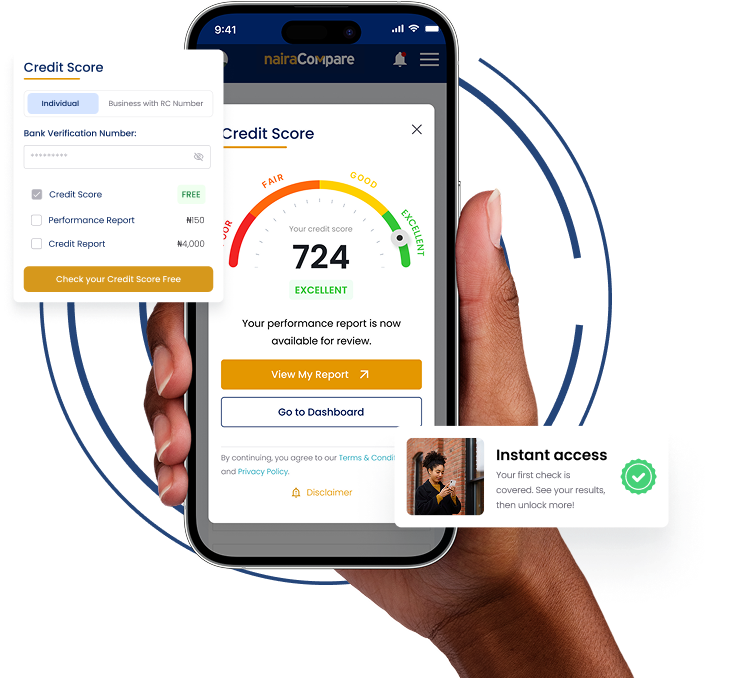
Before doing anything else, check where your score currently stands. You can do this for free at nairacompare.ng/blogs/free-credit-score-check-in-nigeria-a-complete-guide.
Beyond loans, landlords increasingly check credit scores before approving tenancy agreements, especially in Lagos, Abuja, and Port Harcourt. Employers in banking, finance, and sensitive sectors review credit reports during background checks, viewing financial responsibility as an indicator of overall reliability. Mobile phone providers and buy-now-pay-later services also use credit scores when determining deposit requirements or approval decisions.
The Central Bank of Nigeria mandates that all financial institutions report customer credit information to licensed credit bureaus. This means every loan you take, every repayment you make (or miss), and every credit card transaction builds your financial profile. One missed payment on a ₦50,000 loan stays on your credit report for seven years, potentially blocking future borrowing opportunities worth millions.
Increasing your credit score opens doors that poor credit keeps locked. A 100-point improvement can mean the difference between rejection and approval, between paying ₦280,000 or ₦180,000 in annual interest on a ₦1,000,000 loan, and between struggling to find housing and having landlords compete for your tenancy.

What Affects Your Credit Score in Nigeria
Nigerian credit bureaus calculate scores using five main factors, each weighted differently. Understanding these weights helps you prioritise improvement efforts for maximum impact.
Payment History (35% of Your Score)
This single factor carries more weight than any other. Payment history tracks whether you pay debts on time, how often you are late, how late payments are (30, 60, or 90-plus days past due), and whether you have any accounts in collections or defaults.
Every on-time payment strengthens this factor. Every late payment damages it, with severity increasing based on how late the payment is and how recently it occurred. A payment 90 days late hurts more than one 30 days late. A late payment from last month damages your score more than one from three years ago.
Banks, microfinance institutions, fintechs, and digital lenders all report to credit bureaus. Missing a ₦10,000 payment to a loan app affects your score exactly as severely as defaulting on a ₦500,000 bank loan. Credit bureaus do not distinguish between large and small debts when calculating payment history.
Credit Utilisation (30% of Your Score)
This measures how much of your available credit you are using. If you have a credit card with a ₦200,000 limit and you have used ₦150,000, your utilisation is 75%. Credit bureaus view high utilisation (above 30%) as a sign of financial stress, lowering your score even if you make payments on time.
Utilisation applies to all revolving credit: credit cards, overdrafts, and lines of credit. For best results, keep total balances below 30% of total limits. Someone with ₦500,000 in total credit limits should keep outstanding balances below ₦150,000.
Utilisation updates monthly when lenders report to credit bureaus. Paying down balances produces relatively quick score improvements since this factor refreshes every reporting cycle. Reducing utilisation from 80% to 25% can raise your score 30-50 points within two to three months.
Length of Credit History (15% of Your Score)
This reflects how long you have been using credit. Credit bureaus consider the age of your oldest account, the age of your newest account, and the average age across all accounts. Longer credit history generally means higher scores because bureaus have more data to assess your reliability.
Someone who opened their first loan 10 years ago scores higher than someone who started borrowing six months ago, assuming similar payment behaviour. This factor disadvantages young people and those new to formal credit, but consistent positive behaviour on newer accounts eventually builds this component.
Closing old accounts shortens your credit history, potentially lowering your score. If your oldest credit card has been open eight years, keeping it active preserves that history. Closing it might drop your average account age to three years, damaging this factor.
Credit Mix (10% of Your Score)
Credit bureaus reward diversity in credit types. Having a mix of instalment loans (personal loans, car loans, mortgages with fixed monthly payments) and revolving credit (credit cards, overdrafts with variable balances) demonstrates ability to manage different credit structures.
This factor carries less weight than payment history or utilisation, so you should not take unnecessary loans just to diversify credit types. Building credit mix happens naturally over time as financial needs evolve.
New Credit Inquiries (10% of Your Score)
Every time you apply for a loan or credit card, lenders perform a hard inquiry on your credit report, temporarily lowering your score by two to five points. Multiple hard inquiries within short periods signal financial desperation to credit bureaus, compounding the damage.
Hard inquiries stay on your credit report for two years but affect your score most heavily in the first six to twelve months. Five loan applications in one month can drop your score 15-25 points.
Checking your own credit score counts as a soft inquiry that does not affect your rating. Rate shopping for mortgages or car loans within a 14-45 day window counts as a single inquiry, since bureaus recognise you are comparing offers on one major purchase.
How to Increase Your Credit Score: Proven Strategies
Improving your credit score requires addressing the factors that calculate it. These strategies are ranked by impact, with payment history actions producing the fastest and largest improvements.
Strategy 1: Pay All Debts On Time (Addresses Payment History — 35%)
This single action delivers more credit score improvement than any other strategy. Payment history contributes 35% of your score, making on-time payments the foundation of credit improvement.
How to implement: Set up automatic payments for at least minimum amounts due on all credit accounts. Most Nigerian banks and fintech apps offer automatic debit features. Schedule auto-pay two to three days before due dates to account for processing delays. Even if you cannot afford the full payment, paying the minimum amount on time prevents late payment marks on your credit report.
Use calendar reminders for accounts without auto-pay capability. Create phone alerts five days before, two days before, and on the due date for each payment. Prioritise accounts that report to credit bureaus: banks, microfinance institutions, and licensed fintech lenders.
If you currently have limited formal credit history and are looking to start building a track record, nairacompare.ng/blogs/loans/quick-loans/six-best-loans-to-help-you-build-your-credit-score covers six loan options specifically suited for credit-building.
Timeline for results: Your score stops declining the moment you begin making on-time payments. A positive trend is visible in three to six months. Significant improvement follows in 12-24 months as the pattern of consistent payments establishes reliability.
Example: Chidinma had a 520 credit score in January 2026 with a history of late payments on three loans. She set up auto-pay on all accounts and made every payment on time for six months. By July 2026, her score reached 580. By January 2027, it had climbed to 650, qualifying her for loan products she could not access a year earlier.
Strategy 2: Pay Down Credit Card Balances (Addresses Utilisation — 30%)
Reducing credit utilisation produces relatively quick score improvements since this factor updates monthly. Lowering balances below 30% of limits signals to credit bureaus that you are not overextended financially.
How to implement: Calculate your total credit utilisation across all cards and revolving credit. Add up all outstanding balances, divide by total limits, and multiply by 100. Target getting this number below 30%.
Use the debt avalanche or snowball method to pay down balances systematically. The avalanche method pays the highest-interest debt first, saving money on interest charges. The snowball method pays the smallest balance first, providing psychological wins that maintain motivation. Choose whichever keeps you consistent.
Make multiple payments throughout the month instead of one payment on the due date. Credit card companies report balances to bureaus on the statement closing date, which is often different from the payment due date. Paying before the statement closes reduces the balance reported to bureaus, lowering your reported utilisation.
Avoid closing paid-off cards. Closing a card with a ₦200,000 limit whilst carrying a ₦100,000 balance on another card changes your utilisation from 50% across ₦400,000 total limits to 100% on the remaining ₦100,000 limit.
Timeline for results: Utilisation reduction appears in credit reports within one to two billing cycles. Score improvement follows in two to three months. A 30-50 point improvement is possible when dropping from 80% utilisation to below 30%.
Example: Adebayo had ₦450,000 outstanding across three credit cards with ₦600,000 total limits (75% utilisation) and a credit score of 590. He paid ₦300,000 across two months, reducing his balance to ₦150,000 (25% utilisation). Within three months, his score jumped to 635 solely from utilisation reduction.
Strategy 3: Dispute Errors on Yo7ur Credit Report (Immediate Impact)
Credit reports frequently contain mistakes: loans marked as defaulted when you paid on time, accounts belonging to someone else with a similar name, outdated information not removed after resolution, and incorrect payment dates or amounts.
How to implement: Request your full credit report from CRC Credit Bureau or FirstCentral Credit Bureau. You are entitled to one free report annually from each. Review every entry carefully, comparing it against your own records.
Identify specific errors with documentation proving they are wrong. Common errors include payments marked late that you paid on time (prove with a bank statement showing the debit on or before the due date), accounts you never opened (prove with a written statement and, if identity theft is suspected, a police report), and debts already settled still showing as outstanding (prove with a loan closure letter).
File formal disputes with both the credit bureau and the reporting institution. Send written dispute letters via email and registered mail, including copies of supporting documents. Credit bureaus must investigate within 30 days and correct verified errors or explain why they will not.
Timeline for results: A 30-day minimum for investigation, 45-90 days typical for error removal and score recalculation. Immediate score improvement follows once the error is removed. Serious errors such as a false default can produce 50-100-plus point improvements.
Example: Ngozi's credit score was 485. She discovered a ₦150,000 loan marked as defaulted that she had fully repaid three years earlier. She submitted her loan closure letter and bank statements to CRC Credit Bureau and the lender. Within 45 days, the error was corrected and her score jumped to 615.
Strategy 4: Become an Authorised User on Someone's Good Credit
If you have a family member or close friend with excellent credit history, becoming an authorised user on their credit card allows their positive payment history to appear on your credit report.
How to implement: Identify someone with an excellent credit score (750-plus), long credit history (five-plus years), low utilisation (below 30%), and a perfect payment record who trusts you enough to add you. Confirm that the card issuer reports authorised users to credit bureaus before requesting the arrangement.
Agree on clear boundaries with the primary cardholder. Will you receive a physical card? Will you make purchases or is this purely for credit-building? Who pays the bill? A written agreement prevents misunderstandings.
Important warnings: You inherit both positive and negative history. If the primary cardholder starts missing payments or maxing out the card, this damages your credit score even though you did not cause the problem. Use this strategy as a short-term boost whilst you build your own positive history through other methods.
Timeline for results: One to two billing cycles for the authorised user account to appear on your credit report, 30-60 days to see score impact, and a potential 20-50 point improvement.
Strategy 5: Take a Credit-Builder Loan
Credit-builder loans are small loans (typically ₦20,000 to ₦100,000) designed specifically to help people build or rebuild credit. The lender deposits the loan amount into a locked savings account. You make monthly payments and, once the loan is fully repaid, you receive the saved amount plus any interest earned.
How to implement: Apply for a credit-builder loan from a microfinance bank or fintech offering this product. Choose an amount you can comfortably repay. Since the purpose is credit-building, borrow conservatively. Set up automatic payments to ensure a perfect payment record.
After full repayment, you receive your saved amount. Use it to pay down existing debt or build an emergency fund, creating the financial stability that makes future on-time payments easier.
For a broader view of loan apps operating within the FCCPC's approved register, see nairacompare.ng/blogs/best-loan-apps-in-nigeria-safe-options-what-to-avoid-2026 before selecting a platform.
Timeline for results: Six to twelve months for the full benefit. Score improvement is visible after three to four months of on-time payments. A 30-60 point increase is possible over the loan term.
Strategy 6: Keep Old Accounts Open
Closing old credit accounts, especially your oldest ones, shortens your average credit history and reduces total available credit. Both effects damage your score.
How to implement: Identify your oldest credit card or revolving credit account and preserve it, even if you do not use it regularly. Keep old accounts active with small periodic charges. Credit card issuers sometimes close accounts due to inactivity. A small purchase of ₦1,000 to ₦2,000 every three to six months, paid off immediately, maintains the account without carrying balances.
Only close old accounts if they charge fees you genuinely cannot afford, or if keeping them open tempts overspending you cannot control. In these cases, the credit score damage from closure is the lesser harm.
Example: Olumide opened his first credit card in 2018. By 2026, this eight-year-old account significantly boosted his length of credit history. He stopped using the card in 2024 but kept it open with quarterly ₦1,000 purchases paid immediately. His average account age remained 5.5 years instead of dropping to 2.3 years, preserving an estimated 40-50 points on his credit score.
Strategy 7: Limit New Credit Applications
Every loan application creates a hard inquiry that temporarily lowers your score. Strategic timing of applications prevents unnecessary damage.
How to implement: Apply for new credit only when genuinely needed. Research and pre-qualify before formal applications wherever possible. Many lenders offer pre-qualification tools that use soft inquiries to estimate approval odds. Consolidate credit shopping into 14-45 day windows for major purchases such as car loans or mortgages. Wait at least six months between credit card applications.
If you have been rejected and are considering your options, nairacompare.ng/blogs/loans/quick-loan-bad-credit outlines lenders who work with borrowers with poor or thin credit histories, so you can identify which one is most likely to approve your profile before applying.
Timeline for results: Immediate prevention. Six to twelve months for existing hard inquiries to lose impact. Twenty-four months for hard inquiries to fall off your credit report entirely.
Strategy 8: Settle Defaults and Collections
Accounts in collections or marked as defaulted inflict severe credit score damage. Settling these accounts stops additional damage and begins recovery, though settled defaults still appear on credit reports for seven years.
How to implement: Prioritise defaults by age and amount. Recent defaults hurt more than old ones. Large defaults hurt more than small ones. Contact creditors or collection agencies to negotiate settlements. Many accept less than the full amount owed if you pay a lump sum.
Negotiate "pay for delete" where possible, meaning the creditor removes the negative entry entirely after payment. Not all creditors agree to this, so get any such agreement in writing before paying. Pay via bank transfer or another traceable method and retain all documentation permanently.
After settlement, verify on your credit report that the account shows as "settled" or "paid collection." If the lender agreed to delete the entry, confirm it has been removed within 30-45 days of payment.
Timeline for results: Immediate score stabilisation, 30-90 days for the settled status to appear on your credit report, and a 10-50 point improvement depending on the severity of the defaults settled. Full recovery takes one to two years as positive payment history accumulates.
Important: Settling defaults does not erase them from credit history. Settled defaults remain on your credit report for seven years from the original delinquency date but damage your score less than active defaults.
How Long Does It Take to Improve Your Credit Score
Credit score improvement timelines vary based on your starting point, the severity of negative items, and the consistency of your positive actions.
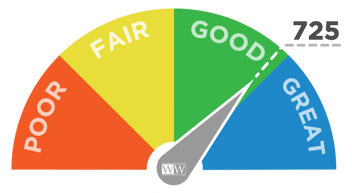
From Poor (below 550) to Fair (550-649): Six to twelve months of consistent positive behaviour. Make all payments on time for six-plus months, reduce credit card balances below 50% utilisation, dispute any errors, and avoid new credit applications. A 50-100 point improvement is realistic.
From Fair (550-649) to Good (650-749): Twelve to twenty-four months of sustained positive behaviour. You need a perfect payment record for twelve-plus months, utilisation below 30%, and minimal hard inquiries. Expect a 50-100 point improvement as recent positive behaviour gradually outweighs older negative marks.
From Good (650-749) to Excellent (750-850): Eighteen to thirty-six months of flawless credit management. This range requires time for credit history length to increase naturally. Optimising every factor produces a 50-100 point improvement.
Specific negative items and their timelines:
- Late payments (30 days): Impact lessens after 12-24 months; removed after seven years.
- Late payments (90-plus days): Severe impact for two to three years, gradually diminishing until seven-year removal.
- Defaults and collections: Severe impact for two to four years, moderate impact until seven-year removal.
- Settled defaults: Moderate impact for one to two years, minor impact until seven-year removal.
- Hard inquiries: Significant impact for six months, minor impact until two-year removal.
Fastest possible improvement: Three months is realistic if high credit utilisation is your only issue and you pay balances down rapidly, or if credit report errors are removed quickly. Six months is realistic for moving from poor to fair with perfect payments and utilisation reduction. Twelve-plus months is required for fair to good, and twenty-four-plus for good to excellent or recovery from multiple serious defaults.
Common Mistakes That Damage Credit Scores
Avoiding these mistakes prevents undoing credit improvement efforts.
Closing credit cards after paying them off. Closing cards reduces your total available credit and shortens your average credit history. Instead, keep paid-off cards open with small periodic charges paid immediately. Only close cards with fees you cannot afford or if the card enables dangerous spending.
Ignoring small debts. Some Nigerians focus on large loans whilst ignoring ₦5,000 or ₦10,000 owed to loan apps or store credit. Credit bureaus do not distinguish between large and small debts when calculating payment history. Settle all outstanding debts regardless of amount. For approved digital lenders you can trust with small credit arrangements, see nairacompare.ng/blogs/loans/loan-apps-low-interest-rates.
Applying for multiple loans when desperate. When one lender rejects an application, desperation often drives people to apply at five more immediately. Each application creates a hard inquiry lowering your score, making subsequent rejections more likely. Wait at least three to six months before applying elsewhere and use that time to improve your score through other strategies.
Co-signing loans without understanding the consequences. When you co-sign someone's loan, that debt appears on your credit report as if you borrowed the money yourself. If the primary borrower misses payments, your credit score drops even though you did not cause the problem. Only co-sign for someone whose financial discipline you trust absolutely, and only for amounts you could afford to repay yourself if they default.
Paying only minimum amounts whilst carrying high balances. Making minimum payments keeps accounts current but does not reduce utilisation if you are carrying balances near credit limits. Whenever possible, pay more than the minimum to move utilisation in the right direction.
Not checking credit reports regularly. Many Nigerians only discover credit report errors when lenders reject applications. By then, the error may have damaged their score for months or years. Check your credit report at least annually. For a step-by-step guide on how to do this for free, visit nairacompare.ng/blogs/free-credit-score-check-in-nigeria-a-complete-guide.
Assuming closed accounts disappear immediately. Closed accounts remain on credit reports for seven to ten years. Closing an account with negative history does not erase that history. The negative marks remain until they age off naturally. Understanding this prevents the false expectation that closure produces an instant score boost.
nairaCompare Insight
For Nigerians starting a credit improvement journey, focus first on payment history and utilisation since these two factors contribute 65% of your score combined. Even if you cannot pay debts in full immediately, paying minimum amounts on time prevents new damage whilst you work on deeper solutions. Set up automatic payments for at least minimums on everything reporting to credit bureaus, then aggressively pay down your highest balances to reduce utilisation below 30%. A borrower with ₦150,000 across two cards on ₦200,000 total limits sitting at 75% utilisation can see a meaningful score improvement in under three months simply by clearing ₦60,000 of that balance.
For those in the fair credit range (550-649) aiming for good credit (650-plus), the challenge shifts from stopping damage to accumulating positive history over time. You need 12-24 months of near-perfect behaviour, which requires systems that prevent mistakes rather than relying on memory. Set calendar alerts for every payment due date, use auto-pay wherever possible, and review your credit report quarterly. If you need to borrow during this period, compare personal loan options at nairacompare.ng/blogs/best-personal-loans-in-nigeria-2026-ranking to find lenders offering competitive rates for your current credit profile.
Frequently Asked Questions
How can I increase my credit score fast in Nigeria?
The fastest improvements come from reducing credit card utilisation and disputing credit report errors. Paying balances from 80% to below 30% of limits can raise your score 30-50 points within two to three months. Removing verified errors such as false defaults can improve your score 50-100-plus points within 30-90 days of correction.
How long does it take to increase a credit score from 500 to 700?
Realistically, 18-36 months of consistent positive financial behaviour. Moving from poor (500) to good (700) requires not just stopping negative behaviour but accumulating substantial positive payment history: 12-plus months of on-time payments, utilisation below 30%, no new defaults, and minimal hard inquiries. Someone with one recent default recovers faster than someone with multiple defaults over several years.
What raises credit score the most in Nigeria?
Making all payments on time carries the most weight since payment history contributes 35% of your score. One year of perfect payments can raise scores 50-100 points. The second most impactful action is reducing credit utilisation below 30%, which can add 30-50 points within two to three months.
Can I increase my credit score in 3 months?
Yes, in specific situations. If high credit card utilisation is your primary issue, paying balances down rapidly can improve your score 30-50 points in three months. If credit report errors are the main problem, disputing and removing them can produce 50-100-plus point improvements within 90 days. If poor payment history is the primary issue, three months of on-time payments helps but will not produce dramatic results. You need six to twelve months for significant payment history impact.
Does settling debt improve credit score immediately?
No. When you settle a defaulted debt, the account status changes from "active default" to "settled collection." This stops ongoing damage but the settled default remains on your report for seven years from the original delinquency date. You might see a 10-30 point improvement within 30-90 days after settlement appears, with continued gradual improvement over 12-24 months.
Should I close credit cards I am not using?
Generally no, unless the card charges annual fees you cannot afford or keeping it open enables overspending you cannot control. Closing unused credit cards reduces your total available credit and potentially shortens your average credit history. Instead, keep unused cards active with small periodic purchases paid immediately.
Can paying off collections remove them from my credit report?
Not automatically. Paying collections changes their status from "unpaid collection" to "paid collection" but does not remove them. You can negotiate a "pay for delete" arrangement where the collection agency agrees to remove the entry entirely after payment, but not all agencies accept this. Get any such agreement in writing before paying.
How many points does a credit score increase per month?
There is no fixed monthly increase. With perfect behaviour, you might see five to fifteen point improvements monthly early in credit recovery. As your score climbs, monthly improvements slow to two to five points. Some months may show no increase or a small decrease due to normal credit activity fluctuations. Focus on three to six month trends rather than month-to-month variations.
Does checking my own credit score lower it?
No. Checking your own credit score counts as a soft inquiry that does not affect your rating. You can check your score as often as you want without any score impact. Only hard inquiries from loan and credit card applications temporarily lower your score.
What credit score do I need to get approved for loans in Nigeria?
Most Nigerian lenders use these general guidelines: 750-850 (excellent) qualifies for the best interest rates and highest loan amounts; 650-749 (good) provides solid approval odds at competitive rates; 550-649 (fair) gets selective approval, often at higher interest rates; below 550 (poor) faces high rejection rates. If your score falls in the fair or poor range and you need credit now, see nairacompare.ng/blogs/loans/quick-loan-bad-credit for options available to you.
Conclusion
Increasing your credit score in Nigeria requires understanding what factors affect scoring, implementing proven improvement strategies, and maintaining consistent positive financial behaviour over months or years. The journey from poor to good credit is not instant, but every on-time payment, every reduction in credit card balances, and every error disputed moves you closer to better loan terms, lower interest rates, and improved financial opportunities.
Do not wait until a lender rejects your next loan application to start improving your credit. Check your score for free on nairaCompare!
This guide provides educational information and does not constitute financial advice. Credit score improvement requires consistent positive financial behaviour over months or years; no service can instantly fix poor credit. Timelines represent typical scenarios; individual results vary based on credit history severity and consistency of improvement actions. Settling defaults improves credit scores gradually but does not erase negative history, which remains on credit reports for seven years. Verify all credit improvement strategies with licensed financial advisers for personalised credit management plans.

Noella Lepdung
Noëlla Lepdung is a writer who makes magic with all sorts of content, helping businesses find their voice and meet their ambitions with cutting-edge but human-first advertising. Her portfolio features brands such as Budweiser, The Coca-Cola Company, Nivea, Leadway Group, Honeywell Foods, Monieworx, Kimberly-Clark, and WAMCO.


Other related articles


.png?width=352&name=march-blog-post1-2026%20(1).png)