
























Where to Invest ₦500,000 in Nigeria: 5 Fixed-Return Platforms Compared
Author Noella Lepdung
Introduction
Half a million naira can be an emergency reserve, a future rent payment, business cash waiting for inventory or capital that will not be needed for a year. Those are different jobs. Before comparing percentages, the investor should decide how much of the money must remain accessible and the earliest date the rest can be locked.
The table below applies ₦500,000 to the published fixed-plan ceilings of FairMoney, Renmoney, Yield and PiggyVest. Cowrywise is included without an invented return because it displays the prevailing rate when a plan is created. The illustrations use simple interest for comparison, are shown before applicable withholding tax and do not imply that every user will receive the maximum rate.
How the Platforms Were Compared
Every provider is assessed on the same ₦500,000 principal, a twelve-month horizon where the published ceiling supports it, access during the term, and the gross return at the stated maximum. A ceiling is not treated as a guaranteed offer. Users should compare the actual maturity value shown in the app before funding.
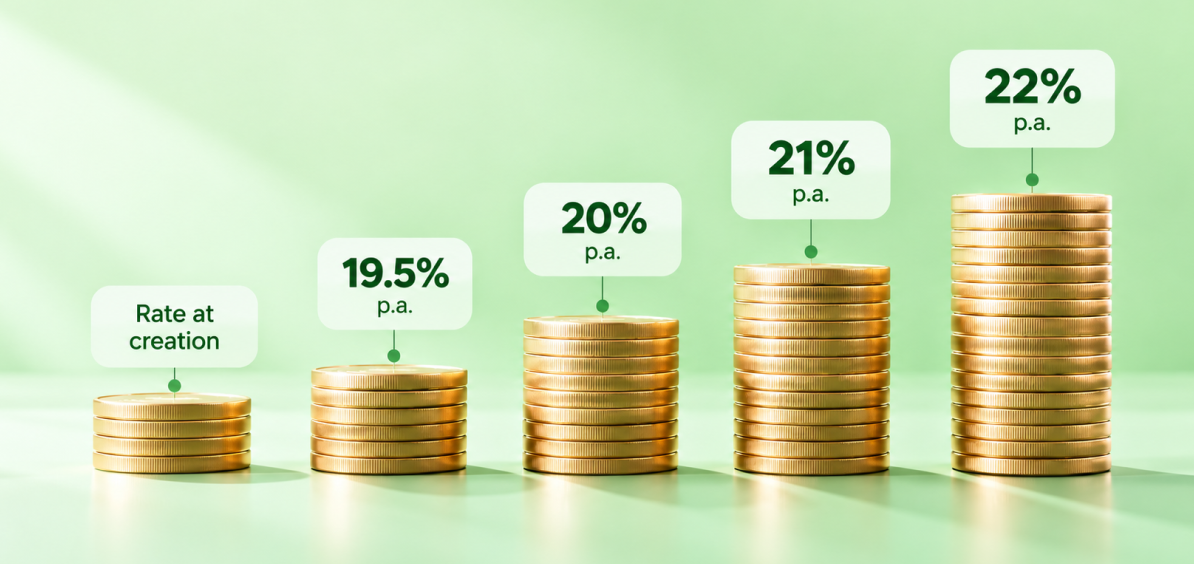
| Platform | Published fixed ceiling | Gross return on ₦500,000 for 12 months | Access | Useful strength | Important limitation |
|---|---|---|---|---|---|
| Renmoney RenVault | Up to 22% per annum | Up to ₦110,000 | Locked for the selected term | Strong published ceiling with a flexible companion product | Complete rate schedule and minimum are not public |
| Yield Fixed | Up to 21% per annum | Up to ₦105,000 | Locked for the selected term of 1 to 12 months | Clear ₦50,000 minimum and published tenure-based rates | 21% applies to the 12-month plan, not every tenure |
| FairMoney FairLock | Up to 25% per annum | Up to ₦125,000 | No withdrawal before maturity | Integrated with a broader banking app | Live and promotional rates may differ |
| PiggyVest SafeLock | Up to 19.5% per annum | Up to ₦97,500 | No access before maturity | Interest can be paid upfront or at maturity | Maximum depends on duration; public minimum not stated |
| Cowrywise Regular Savings | Rate shown at plan creation | Calculate from the live rate | Locked until maturity; minimum duration three months | ₦1,000 periodic minimum and automation | No permanent public headline rate |
Five Fixed-Return Platforms Compared in Detail
1. RenVault: A 22% Published Ceiling
At 22% per annum, ₦500,000 held for twelve months would produce a simple gross return of ₦110,000. That is below FairLock’s current published ceiling but above the remaining platforms with a publicly stated rate in this comparison. The figure should be used only if the app offers 22% for the selected amount and tenure.
The practical question is whether all ₦500,000 can remain locked. If any part may be needed earlier, the user could keep that portion in RenFlex, which advertises up to 15% per annum and allows withdrawals, then place only the genuinely long-dated amount in RenVault.
2. Fixed Yield: ₦105,000 Gross at the 12-Month Ceiling
Fixed Yield’s published 21% ceiling would produce a simple gross return of ₦105,000 on ₦500,000 over twelve months. That is ₦5,000 below RenVault’s published ceiling and ₦20,000 below FairLock’s current published ceiling, before applicable withholding tax.
The rate is clearly tied to a twelve-month plan starting from ₦50,000. The money is locked for the selected term. An investor who needs partial access can compare a split between Fixed Yield and Flex Yield, but should also compare the flexible rates and withdrawal rules of competing platforms before deciding.
3. FairLock: A Fixed Plan Inside an Everyday Banking App
At the current published ceiling of 25% per annum, ₦500,000 held for twelve months would produce a simple gross return of ₦125,000. FairMoney’s strength is the ability to combine the plan with an account, transfers, bills and cards.
The principal cannot be withdrawn before maturity. First-deposit or promotional offers may display a different rate from the standard page, so the user should record the exact rate, maturity date and expected payout shown when creating the plan.
4. PiggyVest SafeLock: Flexible Lock Dates and an Interest-Payment Choice
At 19.5% per annum, ₦500,000 held for twelve months would produce a simple gross return of ₦97,500. PiggyVest allows lock periods from 10 to 1,000 days and lets the user choose interest upfront or at maturity.
This option may be attractive when the desired date is unusual, such as 100 or 400 days, rather than a standard monthly tenor. The principal remains inaccessible until maturity, and the top rate should not be applied to every duration without checking the live plan.
5. Cowrywise Regular Savings: Calculate From the Rate Shown at Creation
Cowrywise shows the prevailing annual rate and potential earnings when the plan is created, then fixes that rate until maturity. If the app displayed 18% for a twelve-month plan, for example, ₦500,000 would produce ₦90,000 gross. That number is an illustration of the calculation, not a claim about the current rate.
The platform’s advantage is accessibility for smaller periodic contributions and automation. Its limitation for a public comparison is that a reader cannot rely on one permanent headline rate without entering the plan journey.
Three Sensible Ways to Divide ₦500,000
- Maximum fixed return: lock the full amount only if there is a separate emergency reserve and the money will not be needed before maturity.
- Balanced access: keep a defined portion in the most suitable flexible product, then compare RenVault, Fixed Yield, FairLock and SafeLock for the remainder.
- Known payment date: choose the platform whose maturity date falls before the obligation, even if another platform displays a slightly higher annual rate.
Practical Recommendations
- For the highest published fixed ceiling in this comparison, check FairLock’s live twelve-month offer.
- For a close alternative with a clearly published minimum and rate, compare Fixed Yield’s ₦50,000 minimum and 21% twelve-month ceiling.
- For unusual lock periods or upfront interest, compare PiggyVest SafeLock.
- For a banking app that combines fixed plans with everyday transactions, compare FairMoney.
- For small automated contributions, use Cowrywise’s live plan calculator before deciding.
Frequently Asked Questions
How are the estimated returns in this comparison calculated?
The illustrations apply simple interest to ₦500,000 for twelve months at each platform’s published maximum annual rate. For example, 21% of ₦500,000 is ₦105,000, giving a gross maturity value of ₦605,000. The calculation does not compound returns and does not deduct applicable withholding tax or product-specific charges.
Does “up to 25% per annum” mean I will earn 25% regardless of tenure?
No. “Up to” identifies the highest advertised annual rate, not the rate attached to every plan. A shorter tenure, different amount or promotional condition may produce another rate. Check the annual rate, actual duration and maturity value displayed for the specific plan before funding it.
What happens if I need the money before maturity?
Fixed products are intended for money that can remain untouched until the agreed date. Depending on the provider, early access may be unavailable or may lead to lost interest or another adjustment. If part of the ₦500,000 may be needed, keep that portion in an accessible account or flexible product and lock only the amount that can remain committed.
Are the return illustrations net of tax?
No. They are gross illustrations. Applicable withholding tax reduces the amount ultimately received. The provider’s maturity figure should show the expected payout, but the investor should confirm whether it is displayed before or after tax.
Is the principal or advertised return guaranteed?
A stated rate makes the expected calculation clearer, but it does not remove provider, operational or regulatory risk. Confirm which regulated entity holds the funds, whether deposit insurance or another protection applies, and what the product terms say about principal and returns. Do not assume that every savings or investment platform has the same protection.
Should I choose the platform with the highest advertised rate?
Only if its access rules, minimum amount, maturity date and provider risk also fit the purpose of the money. A difference of one percentage point equals ₦5,000 gross on ₦500,000 over a full year. That extra return may not compensate for locking emergency money or choosing a maturity date that falls after an important payment.
Can I divide ₦500,000 between fixed and flexible plans?
Yes. One approach is to keep the amount likely to be needed at short notice in a flexible product and place the remainder in a fixed plan. The appropriate split depends on existing emergency savings, upcoming obligations and how certain the investor is about the maturity date.
What should I record before creating a plan?
Save the rate, principal, start date, maturity date, gross and net maturity values, withdrawal rule, applicable tax and any fee or penalty. These details make it easier to compare the eventual payout with the terms accepted at the start.
Conclusion
The headline rate is only one part of the decision. On the published figures reviewed, FairLock shows the highest twelve-month ceiling, while RenVault, Fixed Yield and SafeLock each offer different combinations of rate, minimum amount and plan design.
Cowrywise is harder to compare without entering the plan journey because its prevailing rate is displayed at creation. The suitable choice is the one whose live rate, maturity date, access rule and provider risk match the purpose of the money.
Risk Disclosure and Disclaimer
Returns, rates, minimums and product terms can change. Fixed-return products may restrict access to the principal until maturity, and breaking a plan early may be impossible or may reduce returns. Confirm the provider’s regulatory status, current terms, applicable taxes, fees, maturity value and withdrawal conditions before funding.
This comparison is for general information only and is not personal financial advice or a guarantee of returns. Product information was checked on 27 October 2026 and should be reconfirmed immediately before publication.
About Author
Noella Lepdung
Noella Lepdung, LL.B, is a strategist and writer specialising in financial services, SEO, and digital content. With a background in brand storytelling and organic growth, she creates research-driven content that makes complex topics accessible, engaging, and useful to readers. Her experience spans financial services, healthcare, and consumer brands, and her portfolio includes work for brands such as nairaCompare, Monieworx, Leadway Group, Budweiser, The Coca-Cola Company, Nivea, and Honeywell Foods.

