



.png?width=40&height=40&name=Rectangle%202052%20(2).png)
.png?width=40&height=40&name=Rectangle%202052%20(1).png)




-3.jpg?width=1200&height=628&name=Top%2010%20Health%20Insurance%20Plans%20in%20Nigeria%20in%202026%20(Affordable%20%26%20Reliable%20Options)-3.jpg)
%202.jpg?width=1200&height=628&name=Top%2010%20Health%20Insurance%20Plans%20in%20Nigeria%20in%202026%20(Affordable%20%26%20Reliable%20Options)%202.jpg)

.jpg?width=1200&height=628&name=Best%20Car%20Loans%20in%20Nigeria%20(2026%20Ranking).jpg)



.jpg?width=1200&height=628&name=Your%20Complete%20Guide%20to%20Comparing%20Health%20Insurance%20Plans%20for%20Businesses%20in%20Nigeria%20(2026%20Edition).jpg)
.png?width=1266&height=427&name=blog%20header%20(27).png)
.webp?width=1266&height=427&name=blog%20header%20(38).webp)
%20(1).jpg?width=1200&height=628&name=Complete%20Guide_%20Sending%20Money%20from%20UK%20to%20Nigeria%20(2026)%20(1).jpg)


.png?width=1266&height=427&name=blog%20header%20(19).png)
.png?width=1266&height=427&name=blog%20header%20(30).png)
.webp?width=1200&height=628&name=Health%20Insurance%20Cost%20Report%20(2026).webp)

-1.jpg)
Author Noella Lepdung
Introduction
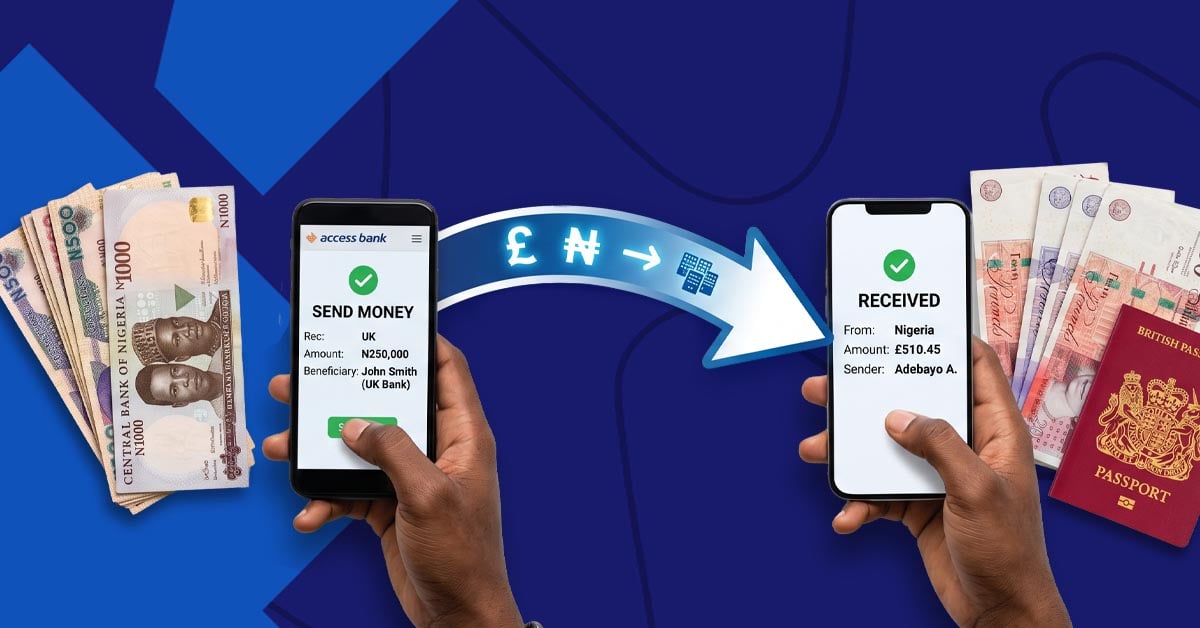
For most UK-to-Nigeria senders, specialist digital platforms offer better rates and faster delivery than high street banks. But bank transfers still have a place: large one-off transfers, institutional paper trails, domiciliary account funding, and property transactions all have situations where SWIFT is the right tool.
This guide explains how UK-to-Nigeria bank transfers work, what they cost, when to use them, and how to get the best result when a bank transfer is genuinely the right choice for your situation.
Table of Contents
- What is a SWIFT Transfer?
- What UK-to-Nigeria Bank Transfers Actually Cost
- What You Will Need
- How to Send Money from the UK to Nigeria by Bank Transfer: Step by Step
- Domiciliary Accounts: The Case for Holding Foreign Currency in Nigeria
- GT Bank London: The Diaspora Banking Option
- Treat Naira4Dollar as a policy-dependent incentive that must be confirmed directly with Zenith Bank or CBN circulars at the time of transfer, rather than a consistently active feature of Zenith Bank services.
- When Bank Transfers Beat IMTOs
- Common Mistakes to Avoid
- nairaCompare Insight
- Frequently Asked Questions
- Related Resources
- Conclusion
What is a SWIFT Transfer?
SWIFT stands for Society for Worldwide Interbank Financial Telecommunication. It is the global messaging network that banks use to instruct each other to move money across borders. When you initiate an international transfer from a UK bank account, your bank sends a SWIFT message to your recipient’s Nigerian bank, instructing it to credit the recipient’s account.
The transfer does not move actual money directly between banks in real time. Instead, it moves through a chain of correspondent banks, each holding accounts with the others, until the funds reach the destination. This is why SWIFT transfers typically take two to five business days and why correspondent bank fees can be deducted along the way.
Every Nigerian bank that accepts international transfers has a SWIFT code, also called a BIC (Bank Identifier Code). This is the identifier your UK bank uses to route the transfer to the correct Nigerian institution. Getting this code right is essential; sending to a wrong or outdated SWIFT code can cause delays or misdirected funds.
What UK-to-Nigeria Bank Transfers Actually Cost
Bank transfer costs have three components, and many senders only notice the first one.
Transfer fee: UK high street banks typically charge £15 to £25 per outgoing international transfer. Some premium account holders pay less or nothing, but these are the standard retail rates for Barclays, HSBC, Lloyds, and NatWest.
Exchange rate markup: this is the invisible cost. UK banks apply a margin of 2% to 5% above the mid-market GBP/NGN rate. On a £1,000 transfer with a 3.5% markup, that is £35 in additional cost beyond the flat fee, and it shows nowhere on the fee summary. The mid-market rate is the only honest benchmark. Check it on nairaCompare before every bank transfer.
Correspondent bank fees: funds passing through intermediary banks on the way to Nigeria can attract deductions of $10 to $25 per correspondent bank. These are charged by banks in the correspondent chain, not by your UK bank, so your UK bank often cannot tell you in advance exactly what will be deducted. Your recipient may receive less than the amount your bank confirms sending.
|
UK Bank |
Transfer Fee |
Rate Markup (typical) |
Total Cost on £1,000 (approx.) |
|
Barclays |
£25 |
3–4% |
£55–65 above mid-market cost |
|
HSBC |
£20–25 |
2.5–4% |
£45–65 above mid-market cost |
|
Lloyds |
£20 |
3–4% |
£50–60 above mid-market cost |
|
NatWest |
£22 |
3–4% |
£52–62 above mid-market cost |
|
GT Bank London |
Verify directly |
More competitive for NGN corridor |
Generally lower for Nigeria route |
Figures are indicative. Verify current fees and rates directly with your bank before sending. Correspondent bank deductions are additional and variable.
What You Will Need
Before initiating a UK-to-Nigeria bank transfer, confirm you have the following.
- Your recipient’s full legal name as it appears on their Nigerian bank account
- Their ten-digit Nigerian bank account number
- The Nigerian bank’s SWIFT/BIC code (see common codes below)
- The Nigerian bank’s full branch address (required by some UK banks)
- Your recipient’s BVN, for some bank-specific requirements
- The purpose of the transfer (family support, tuition, property, business) — UK banks may ask
- For domiciliary account transfers: the currency of the account (GBP, USD, or EUR) to avoid forced naira conversion
Common Nigerian bank SWIFT codes for reference:
|
Bank |
SWIFT/BIC Code |
Notes |
|
GT Bank |
GTBINGLA |
Physical London branch available |
|
Access Bank |
ABNGNGLA |
Accepts GBP domiciliary deposits |
|
Zenith Bank |
ZENITHNGLA |
Naira4Dollar scheme participant |
|
UBA |
UNAFNGLA |
UK presence via UBA UK Ltd |
|
First Bank |
FBNINGLA |
Verify branch code for domiciliary |
Always verify SWIFT codes directly with the recipient’s bank before sending. Codes can change and using an outdated code may cause delays or misdirected transfers.
How to Send Money from the UK to Nigeria by Bank Transfer: Step by Step
- Check the mid-market GBP/NGN rate on nairaCompare before logging into your bank. This gives you a benchmark. If your bank’s offered rate is more than 3% below mid-market, consider whether an IMTO would better serve this transfer.
- Confirm the recipient’s account details in full: full name, account number, bank name, and SWIFT code. For domiciliary account transfers, confirm the currency of the account explicitly. A GBP domiciliary account should receive GBP. If you send GBP to a naira account, the Nigerian bank will convert at its own rate, which may be unfavourable.
- Log into your UK bank’s online or mobile banking and navigate to international payments. Select the destination country (Nigeria) and enter the recipient’s details exactly as they appear on their account.
- Enter the transfer amount. Review the exchange rate your bank is offering and compare it against the mid-market rate you checked in Step 1. The difference is the effective cost of the rate markup.
- Select your payment purpose accurately. UK banks are required to record the purpose of international transfers for anti-money laundering compliance. Common options are family support, education fees, property purchase, or business payment. Selecting an inaccurate purpose can trigger compliance reviews and delays.
- Confirm and authorise the transfer. Save the transaction reference number and any confirmation details your bank provides. Send the reference to your recipient so they can follow up with their bank if the funds do not arrive within the stated window.
- Follow up if funds do not arrive within five business days. Contact your UK bank with the transaction reference. They can initiate a SWIFT trace to identify where in the correspondent chain the transfer is held.
- Keep records of the transaction for tax purposes, particularly for large transfers related to property, business, or investments. Both HMRC and the Nigeria Revenue Service under the Tax Act 2025 may have reporting interests in significant cross-border transfers.
Domiciliary Accounts: The Case for Holding Foreign Currency in Nigeria
A domiciliary account is a foreign currency account held at a Nigerian bank. It allows your recipient to hold funds in GBP, USD, or EUR without converting to naira immediately. This is particularly valuable when the naira is under pressure, as it means the recipient can choose when to convert rather than being forced to accept whatever rate their bank applies on receipt.
GTBank, Access Bank, Zenith Bank, UBA, and First Bank all offer domiciliary accounts. The account must be specifically designated for the currency you are sending. Sending GBP to a USD domiciliary account will trigger a currency conversion at the Nigerian bank’s rate, which may be less favourable than converting yourself.
For regular senders making large monthly transfers, opening a domiciliary account for your recipient is worth the one-time setup effort. It gives your recipient control over when and how they convert, which over time can result in meaningfully better naira values on the same amount sent.
Important: ask the recipient’s Nigerian bank whether they charge an incoming international transfer fee. Some Nigerian banks deduct a charge from the received amount. GT Bank, Zenith, and Access Bank have all charged incoming SWIFT fees at various times. Confirm the current position before sending.

GT Bank London: The Diaspora Banking Option
GT Bank operates a physical branch in London, making it the most accessible diaspora banking option for UK-based Nigerians. UK residents can open a Non-Resident Nigerian (NRN) account in person at the London branch, which allows them to send money to Nigeria through GT Bank’s own network rather than through a third-party UK bank.
The GT Bank London route typically offers more competitive GBP/NGN rates than a standard UK high street bank for transfers to Nigeria, because the transfer stays within GT Bank’s own network. It also simplifies the correspondent bank chain, reducing the risk of intermediate deductions. For Nigerians in the UK who send regularly to a GT Bank account in Nigeria, this is worth exploring as a lower-cost alternative to other UK banks.
Verify current GT Bank London account terms, fees, and rate conditions directly with the branch before relying on this guide. Terms change and the branch may have specific account eligibility requirements.
The Zenith Bank Naira4Dollar Scheme
Zenith Bank participates in the CBN’s Naira4Dollar scheme, which provides a small additional naira incentive per dollar received through licensed channels. The scheme is designed to encourage inbound remittances through formal banking channels and rewards recipients with an additional naira amount per dollar received into their Zenith Bank account.
The incentive amount and eligibility conditions are set by the CBN and are subject to change. Verify the current rate and terms directly with Zenith Bank before factoring this into your transfer decision. It is worth checking whether the incentive meaningfully offsets the cost difference between a Zenith SWIFT transfer and an IMTO for your typical transfer amount.
When Bank Transfers Beat IMTOs
For most regular remittances, IMTOs offer better rates, lower fees, and faster delivery. However, there are specific situations where a bank transfer is the right choice.
- Large property transactions: transfers of £50,000 and above for property purchases typically require documented bank-to-bank transfer records that satisfy legal and title registration requirements in Nigeria. An IMTO transfer may not generate the documentation a Nigerian property lawyer needs.
- Domiciliary account funding: if your recipient holds a foreign currency domiciliary account and wants to receive the funds in GBP without conversion, a SWIFT transfer is the most straightforward route.
- Business and corporate transfers: business-to-business international transfers are handled through bank SWIFT infrastructure rather than consumer IMTO platforms, which are designed for personal remittances.
- Institutional paper trail requirements: for immigration, legal, or financial documentation purposes, some processes require a bank-generated international transfer certificate or SWIFT confirmation rather than an IMTO receipt.
- Very large one-off amounts: for transfers above £10,000, some IMTOs impose limits or require additional verification that may not be immediately available. A bank transfer may be more straightforward for very large one-off transactions.
Common Mistakes to Avoid
Sending to a naira account when you intended a domiciliary account. the recipient ends up with naira at the Nigerian bank’s conversion rate rather than holding foreign currency. Confirm the account type before initiating the transfer.
Using an outdated SWIFT code. Nigerian banks occasionally update their SWIFT codes. Always verify the current code directly with the recipient’s bank rather than relying on a remembered or internet-sourced code.
Ignoring correspondent bank deductions. expecting your recipient to receive the exact amount you send is unrealistic on SWIFT transfers. Build in a small buffer for correspondent bank fees, and warn your recipient that the received amount may be slightly less than the sent amount.
Not recording the transfer purpose accurately. Mis-recording the purpose of a large international transfer can trigger AML reviews and freeze the transfer mid-chain. Use the accurate purpose category every time.
Comparing flat fees without accounting for the rate markup. a bank advertising £15 transfer fee sounds cheaper than a £20 fee, but if the first bank applies a 4% rate markup and the second applies 2%, the second bank is almost certainly cheaper on any transfer above a few hundred pounds.
nairaCompare Insight
For Nigerians in the UK sending money home for everyday family support, a UK high street bank is rarely the right tool. The combination of flat fees and hidden rate markups means most senders are paying £50 to £100 more per £1,000 sent than they need to. That gap is real money that belongs with your family, not your bank. Use the nairaCompare send money comparison tool to see what you would receive on a specialist platform before confirming any bank transfer. The comparison takes under two minutes.
For Nigerians in the UK handling larger or more complex transfers, such as property purchases, business payments, or domiciliary account funding, a bank transfer is often the right choice for reasons that go beyond cost. The GT Bank London branch and Zenith Bank’s Naira4Dollar scheme are worth exploring for anyone in this category. The key is to use banks where they genuinely serve your needs rather than out of habit. Our comparison tool shows where banks are competitive and where they are not, so you can make the decision based on current data rather than assumption.
Frequently Asked Questions
How long does a SWIFT transfer from the UK to Nigeria take?
Two to five business days is the standard range. GT Bank London transfers within its own network may be faster. Transfers passing through multiple correspondent banks or flagged for compliance review can take longer. Always initiate time-sensitive transfers at least five working days before the funds are needed.
What is the SWIFT code for GT Bank Nigeria?
Always verify the exact SWIFT/BIC code directly with the recipient’s specific GT Bank branch or official bank channel before initiating a transfer, rather than relying on a single “standard” code listed in guides.. Always verify directly with the recipient’s branch before using any SWIFT code, as codes can vary by branch or change over time.
Can I send money to a domiciliary account from a UK bank?
Yes. Ensure you specify the currency of the domiciliary account when initiating the transfer, and confirm with the recipient’s bank that the account is active and accepts inbound SWIFT transfers in that currency. Sending the wrong currency to a domiciliary account triggers an automatic conversion at the Nigerian bank’s rate.
Will my recipient be charged for receiving a SWIFT transfer?
Some Nigerian banks charge an incoming international transfer fee, which is deducted from the received amount. This varies by bank and can range from a nominal charge to $20 or more. Ask the recipient’s bank before sending, and factor this into your transfer amount if relevant.
Can I use a UK bank for regular monthly remittances?
You can, but it is rarely cost-effective. For regular monthly remittances of moderate amounts, specialist IMTOs consistently offer better rates, lower fees, and faster delivery. Bank transfers are better suited to large, infrequent, or documentation-sensitive transfers.
What happens if my SWIFT transfer goes to the wrong account?
Contact your UK bank immediately with the transaction reference and the error details. Banks can initiate a SWIFT recall, though recovery is not guaranteed and can take several weeks. Prevention through careful double-checking of recipient details before sending is essential.
Is there a maximum amount I can send via SWIFT from the UK?
UK banks have no regulatory maximum for international transfers, but large transfers trigger enhanced compliance checks under anti-money laundering rules. Transfers above £10,000 may require additional documentation on the source of funds. HMRC may also request information on large international transfers.
Conclusion
SWIFT bank transfers remain a legitimate and sometimes necessary part of the UK-to-Nigeria sending landscape. For large property transactions, domiciliary account funding, and situations where a documented institutional paper trail matters, they serve a purpose that specialist digital platforms do not fully replace. For everyday family remittances, they are almost never the cheapest or fastest option.
Before your next transfer, check the current mid-market GBP/NGN rate on nairaCompare and compare what your bank is offering against specialist platforms. For most transfers, the five-minute comparison will show you a meaningfully better option. For the transfers where a bank genuinely makes sense, knowing the cost in advance means no surprises for you or your recipient.
Exchange rates and bank fees are indicative and subject to change. SWIFT codes should be verified directly with the recipient’s bank before use. This content is for informational purposes only and does not constitute financial advice.
Noella Lepdung
Noella Lepdung, LL.B, is a strategist and writer specialising in financial services, SEO, and digital content. With a background in brand storytelling and organic growth, she creates research-driven content that makes complex topics accessible, engaging, and useful to readers. Her experience spans financial services, healthcare, and consumer brands, and her portfolio includes work for brands such as nairaCompare, Monieworx, Leadway Group, Budweiser, The Coca-Cola Company, Nivea, and Honeywell Foods.


Other related articles
.jpg?width=352&name=SWIFT%20Bank%20Transfer%20Guide%20(Canada%20to%20Nigeria).jpg)
.png?width=352&name=blog%20header%20(1).png)
.jpg?width=352&name=Complete%20Guide_%20Sending%20Money%20from%20UK%20to%20Nigeria%20(2026).jpg)
.webp?width=352&name=Best%20IMTOs%20for%20Canada%20to%20Nigeria%20Transfers%20(1).webp)