A loan app can make borrowing feel like a product-selection exercise: download, enter a few details and choose an amount. The real decision begins after the application, when the lender reveals the approved amount, repayment dates, fees and total amount due. A large advertised ceiling may be irrelevant to a new borrower, while a quick approval may be poor value if the monthly instalment leaves no room for ordinary expenses.
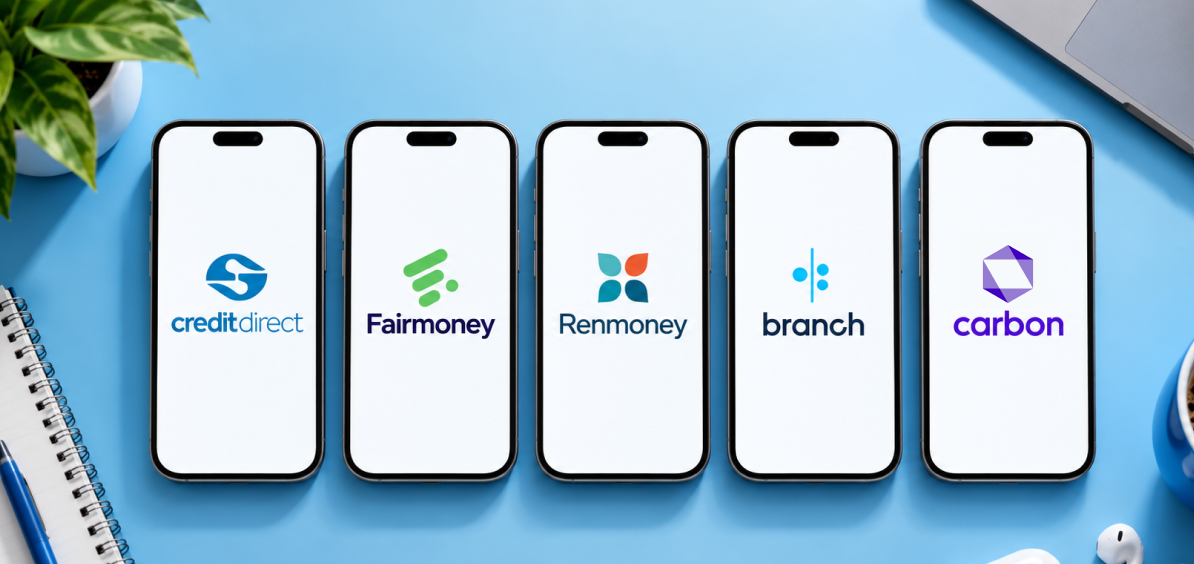
The five providers below are established names in Nigeria’s digital-credit market. Each has a genuine strength. Renmoney states the largest ceiling and provides a representative pricing example. FairMoney places credit inside a broader bank account. Branch accommodates small starting requests. Carbon combines lending with account and card controls. Credit Direct states a salary-led route with a substantial ceiling and additional transaction and returns features. None is automatically cheapest because the final price remains personal to the borrower.
How the Options Were Compared
The comparison uses the same criteria for every provider: published loan range, maximum tenor, public pricing information, stated eligibility, wider app functions and an important limitation. App-store and provider terms can change, and advertised limits are ceilings rather than guaranteed approvals. Where a provider does not publish a standard figure, the table says so instead of filling the gap with an assumption.
| App |
Published range |
Maximum tenor |
Published pricing |
Genuine strength |
Important limitation |
| FairMoney |
Up to ₦3 million |
Not stated on current listing |
₦100,000 example totals ₦130,000; representative APR 120% |
Credit within a broad digital-bank account |
Public listing does not state the maximum tenor |
| Renmoney |
Up to ₦10 million |
Up to 24 months |
Representative example: 2.49% monthly; 29.88% APR; 1% management fee |
Largest published ceiling and relatively clear rate range |
A 1% management fee appears in its representative example |
| Branch |
₦6,000 to ₦2 million |
Up to 12 months |
3% to 23% monthly; 34% to 271% APR |
Low starting amount for modest requests |
Very wide published price range |
| Credit Direct |
Up to ₦5 million |
Up to 12 monthss |
Pricing and repayment details shown in the personalised offer; no standard APR range listed on the public page reviewed |
Private-sector salary earners; other products have separate criteria |
₦100,000 net-salary threshold; pricing appears only in the offer |
| Carbon |
₦10,000 to ₦2 million |
Up to 12 monthss |
4.5% to 30% monthly; maximum APR 195% |
Account, payment and card controls alongside credit |
Wide pricing range; offer depends on risk profile |
Five Loan Apps Compared in Detail
1. FairMoney: Credit Within a Digital-Bank Account
FairMoney advertises personal loans of up to ₦3 million, subject to eligibility. Its current listing also presents an account, transfers, bill payments and other banking functions, which can appeal to someone who wants borrowing and everyday transactions in one place.
Its representative example is useful because it translates pricing into naira: a ₦100,000 three-month loan carries ₦30,000 in interest and ₦130,000 total repayment, with a stated 120% APR. The limitation is that the current listing does not publish a maximum tenor. A borrower therefore has to judge the personalised schedule rather than assume that a longer repayment period will be available.
2. Renmoney: The Largest Published Loan Ceiling
Renmoney advertises loans of up to ₦10 million and repayment of up to 24 months. Its current representative example uses a ₦2 million loan over 12 months at 2.49% monthly, a 29.88% APR and a 1% management fee. An applicant’s actual offer may differ.
The advertised ceiling is still not an entitlement. Eligibility requires a verifiable source of income and assessment, and Renmoney’s representative example includes a 1% management fee. Its main strength is the potential loan size; its practical limitation is that a larger approval can produce a demanding monthly instalment within the approved repayment term.
3. Branch: A Low Entry Point for Smaller Requests
Branch states a starting amount of ₦6,000 and a ceiling of ₦2 million, with repayment from 62 days to one year. That range makes it relevant to borrowers who need a modest sum and do not want to begin their comparison at a seven-figure amount.
The limitation is pricing dispersion. Its published monthly rate runs from 3% to 23%, with an APR range of 34% to 271%. Two applicants can therefore receive materially different offers. Branch’s lower entry point is a strength, but the total repayment shown to the individual borrower matters far more than the minimum amount.
4. Credit Direct: A Salary-Led Loan With Wider App Functions
Credit Direct offers eligible private-sector employees loans of up to ₦5 million for as long as 12 months through its app. Its public criteria include Tier 2 KYC, a minimum net salary of ₦100,000, at least six months of salary history and a satisfactory credit record. These requirements make the likely audience clearer before someone applies.
The app also provides free transfers, bill payments, 10% per annum on wallet balances, and investment plans paying up to 21% per annum. Those features may add value after disbursement. The limitation is equally important: the ₦100,000 threshold excludes some earners, and the public page does not publish a standard APR range, so cost comparison begins only when the personalised offer appears.
5. Carbon: Credit With Account and Card Controls
Carbon advertises consumer loans from ₦10,000 to ₦2 million with terms from 61 days to 12 months. It also provides account, payment and card-management features, including controls that may appeal to someone already using the platform for daily transactions.
Carbon’s published monthly rate ranges from 4.5% to 30%, with a maximum APR of 195%. The platform’s broader banking controls are its distinguishing strength. Its published pricing spans a wide range, so the personalised total repayment remains more useful than the headline minimum or maximum rate.
Frequently Asked Questions
Why can two applicants receive different rates from the same loan app?
Digital lenders price loans using factors such as income, existing obligations, credit history, repayment behaviour, requested amount and tenure. Two people applying for the same amount can therefore receive different rates, limits and repayment schedules. Compare the offer generated for you, not another borrower’s screenshot or the provider’s maximum advertised amount.
What is the difference between a monthly interest rate and APR?
A monthly rate describes interest charged for a month, while the annual percentage rate expresses borrowing cost on a yearly basis using a standardised measure. Multiplying a monthly rate by twelve does not always reproduce the disclosed APR because the repayment structure, fees and calculation method can affect the annualised result.
Why can the APR look much higher than the monthly rate?
APR converts the cost of a loan into an annual measure, even when the actual loan lasts only a few months. A short loan with monthly charges can therefore display a high APR. This does not mean the borrower will pay the APR percentage of the principal in cash. The figures to examine together are the APR, cash fees, instalments and total amount payable.
Does an advertised maximum mean a first-time borrower can receive it?
No. Published limits are ceilings. A new customer may receive a much smaller offer after identity, affordability and credit checks. Request only what is needed and assess the instalment against dependable monthly income rather than planning around the advertised maximum.
Which charges should I include when comparing two loan offers?
Include interest, management or utilisation fees, processing charges, insurance where applicable, and any amount deducted before disbursement. Also check late-payment charges and early-settlement terms. The cleanest comparison is between the cash actually received and the total naira amount that must be repaid.
Can early repayment reduce the cost of a digital loan?
It depends on the agreement. Some lenders recalculate interest or allow early settlement, while others require the amount already stated in the schedule or apply specific conditions. Check the early-settlement figure with the lender before paying ahead. Do not assume that sending the outstanding principal automatically closes the loan.
What happens if I miss a repayment?
The lender may apply charges, attempt collection through the authorised repayment method, contact the borrower and report the missed payment to a credit bureau. Continued default may lead to external collection or legal action under the agreement. Contact the lender before the due date if repayment difficulty becomes likely.
Can taking a digital loan affect my credit record?
Yes. On-time repayment can contribute to a positive borrowing history, while missed or late payments can make future credit more difficult or expensive to obtain. A declined application may also reflect information in a credit report, so borrowers should correct any genuine error through the relevant lender or credit bureau.
What should I save before accepting an offer?
Keep the offer letter or in-app summary showing the amount approved, amount disbursed, rate, APR, fees, instalments, due dates, total repayment, late-payment terms and early-settlement rules. Save payment receipts and closure confirmation as well.
How should I compare two personalised offers?
Start with the total amount payable, then examine the monthly instalment, APR, fees and repayment dates. A lower instalment may result from a longer tenor and can still produce a higher total cost. The more suitable offer is the one whose complete cost and schedule fit the borrower’s cash flow, not simply the one with the larger limit.
Conclusion
There is no universally cheapest or most suitable loan app. Renmoney publishes the largest ceiling in this comparison, Branch has the lowest stated starting amount, FairMoney and Carbon combine credit with wider account functions, and Credit Direct provides a clearly defined route for eligible private-sector salary earners. The decisive comparison happens after approval: the amount disbursed, APR, fees, repayment dates, instalment and total amount payable shown in the individual offer.