


.png?width=40&height=40&name=Rectangle%202052%20(2).png)
.png?width=40&height=40&name=Rectangle%202052%20(1).png)







.jpg?width=1200&height=628&name=Your%20Complete%20Guide%20to%20Comparing%20Health%20Insurance%20Plans%20for%20Businesses%20in%20Nigeria%20(2026%20Edition).jpg)
.png?width=1266&height=427&name=blog%20header%20(27).png)
.webp?width=1266&height=427&name=blog%20header%20(38).webp)
%20(1).jpg?width=1200&height=628&name=Complete%20Guide_%20Sending%20Money%20from%20UK%20to%20Nigeria%20(2026)%20(1).jpg)


.webp?width=1200&height=628&name=Health%20Insurance%20Cost%20Report%20(2026).webp)

.png?width=1266&height=427&name=blog%20header%20(19).png)
.png?width=1266&height=427&name=blog%20header%20(30).png)

.png)
Author Noella Lepdung
Starting or scaling a business in Nigeria requires capital, and for most entrepreneurs, that means securing financing. Whether you're a sole trader needing working capital, an SME owner looking to expand, or a startup seeking equipment financing, understanding the business loans in Nigeria landscape is crucial for making informed decisions.
The good news? Nigeria's lending environment is evolving. As commercial banks will begin lowering interest rates on loans in 2026, current rates of 32-36% are expected to decline as banks shift focus toward real sector financing. This shift creates opportunities for businesses that have struggled with high borrowing costs.
This comprehensive guide covers everything you need to know about business loans in Nigeria for 2026, from understanding different loan types and comparing the best banks for small business loans, to exploring federal government loans, private lenders, and alternative fintech options.
Understanding the Business Loan Landscape in Nigeria
What Are Business Loans?
Business loans are funds borrowed specifically to meet commercial needs, whether for startup capital, equipment purchases, inventory financing, or expansion projects. Unlike personal loans, business loans typically offer higher amounts, longer repayment terms, and specialized features designed for commercial use.
In Nigeria, loans for small business remain critically underfunded despite SMEs accounting for over 90% of Nigerian enterprises. Less than 5% of commercial bank lending goes to MSMEs, creating a significant financing gap that government interventions, development banks, and fintechs are now working to address.
Current Interest Rate Environment
Business loan interest rates in Nigeria vary dramatically by lender type: Bank of Industry and CBN intervention funds offer the most affordable rates at 7-12% annually, commercial banks charge 18-30%, microfinance institutions range between 18-30%, while fintech platforms can reach 60% APR or higher.
The Central Bank of Nigeria's Monetary Policy Rate (MPR) directly influences these rates. After peaking at 27.5% in 2024, analysts expect gradual easing through 2026 as inflation moderates and banks deploy accumulated capital into productive lending.
Types of Business Loans Available
| Loan Type | Best For | Typical Amount | Repayment Period |
|---|---|---|---|
| Term Loans | Equipment purchase, expansion projects | ₦500,000 - ₦50 million+ | 1-10 years |
| Working Capital Loans | Inventory, day-to-day operations | ₦100,000 - ₦10 million | 3-24 months |
| Overdraft Facilities | Cash flow management | Varies by account | Revolving credit |
| Asset Financing | Vehicles, machinery, equipment | Up to 80% of asset value | 1-5 years |
| Invoice Discounting | Immediate cash from outstanding invoices | 70-90% of invoice value | Until invoice payment |
| Trade Finance | Import/export operations | Transaction-specific | 30-180 days |
Understanding which loan type matches your business needs is the first step toward successful financing. Learn how to assess your business needs and goals before applying for a business loan to determine the right fit.
Going to Banks for SME Loans in Nigeria
Commercial banks remain the primary source of structured business financing in Nigeria. When seeking the best banks for small business startup loans in Nigeria, entrepreneurs should consider several top-tier institutions offering competitive rates and specialized SME support.
Access Bank leads with extensive digital lending infrastructure and both secured and unsecured business loans, while First Bank's SMEConnect platform provides valuable training for first-time borrowers navigating the business loan application process. Zenith Bank and GTBank excel in digital banking with quick loan processing and transparent fee structures, making them ideal for tech-savvy business owners.
For businesses seeking SME loans for small business with flexible terms, UBA offers diverse credit facilities with pan-African reach, while Sterling Bank is renowned for fast processing and sector-specific financing solutions. Stanbic IBTC stands out for collateral-free options, particularly valuable for startups lacking fixed assets, and Fidelity Bank provides relationship-based lending with quick approval for qualified applicants.
EcoBank specializes in trade finance across multiple African markets with comprehensive credit facilities including overdrafts and invoice discounting, while Union Bank offers some loans at single-digit interest rates for qualifying businesses alongside traditional commercial products. Things to note:
- Interest rates for small business loans in Nigeria from commercial banks typically range from 18-30% annually, though rates vary based on credit profile, collateral offered, and relationship history with the bank.
- Most banks now offer digital application channels, reducing processing times from weeks to days for qualified borrowers with complete documentation.
Click below to compare SME loans and see current rates, requirements, and features side-by-side across these banks and additional lenders:

Federal Government Loans for Small Business in Nigeria
Government intervention funds represent the most affordable financing option for Nigerian businesses. These federal government loans for small business in Nigeria typically offer single-digit interest rates and longer repayment terms than commercial alternatives.
Bank of Industry (BOI) Loans
The Bank of Industry remains the most accessible source of affordable business financing in Nigeria. BOI focuses on manufacturing, agriculture, renewable energy, and tech startups with local value addition.
Interest Rates: 7-12% per annum
Loan Tenor: Up to 10 years (scheme-dependent)
Grace Period: 3-12 months before repayment begins
Collateral: Movable or immovable assets; may include guarantor or bank guarantee
Eligible Sectors:
- Manufacturing and processing
- Agro-allied industries
- Renewable energy projects
- Technology and innovation
- Healthcare services
- Creative industries
While BOI offers the best rates in the market, access requires strong documentation, comprehensive business plans, and patient follow-up through partner banks.
Central Bank of Nigeria (CBN) Intervention Programs
The CBN manages several specialized funds targeting different sectors and business categories:
MSME Development Fund
Single-digit interest loans distributed through microfinance institutions to registered micro, small, and medium enterprises.
Key Features:
- Rates as low as 5-9% annually
- Disbursed through participating MFIs
- Focus on job creation and local production
Real Sector Support Facility (RSSF)
Low-interest loans for manufacturing, agricultural processing, and value addition businesses.
Key Features:
- Supports import substitution initiatives
- Longer repayment terms for equipment
- Competitive rates for productive sectors
Agric-Business/Small and Medium Enterprises Investment Scheme (AGSMEIS)
5% interest rate loans for registered businesses with viable business plans in agriculture and SME sectors.
Key Features:
- Extremely low 5% annual interest
- Requires CAC registration
- Comprehensive business plan mandatory
- Focus on agricultural value chain
Creative Industry Financing Initiative (CIFI)
Targets entertainment, technology, and creative sector entrepreneurs with affordable funding.
Key Features:
- Specialized for creative industries
- Single-digit interest rates
- Supports content production, distribution
- Technology innovation funding
Small and Medium Enterprises Development Agency of Nigeria (SMEDAN)
SMEDAN, funded by the Nigerian government, provides business development support and financing. Recent initiatives include the ₦5 billion SMEDAN x Sterling MSME Fund targeting registered Nigerian-owned SMEs.
Key Features:
- Business development training
- Access to markets and linkages
- Mentorship programs
- Competitive grant and loan opportunities
Bank of Agriculture (BOA) Loans
For agribusiness entrepreneurs, the Bank of Agriculture provides specialized financing across the agricultural value chain-from production to processing and export.
Loan Products:
- Women in Agriculture (WIA): ₦50,000 - ₦500,000 for female farmers
- Youth Agricultural Resource Network (YARN): ₦1-5 million for youth agripreneurs
- Input Loans: Financing for seeds, fertilizer, equipment
- Processing Loans: ₦5-50 million for agro-processing businesses
- Export Financing: ₦5 million+ for agricultural exporters
Interest Rates: Typically 7-12% annually (significantly lower than commercial banks)
Collateral: Required, but cooperatives can use group guarantees
Application: Through BOA branches nationwide with business plan and documentation
BOA remains crucial for Nigeria's agricultural financing, providing affordable credit to a sector often ignored by commercial banks.
Private Lenders for Business Startup Loans in Nigeria
Beyond traditional banks and government programs, private lenders for business startup loans in Nigeria have expanded significantly, offering faster processing and more flexible requirements.
Fintech Lending Platforms
Nigeria's fintech revolution has transformed business financing access. Digital lenders use alternative credit scoring-BVN data, transaction history, mobile money patterns-to approve loans commercial banks would reject.
Carbon (formerly Paylater)
Loan Amount: ₦2,500 - ₦1,000,000
Interest Rate: 4.5-30% monthly (54-195% APR)
Repayment Period: 61 days to 12 months
Key Feature: No collateral or guarantor required; rates improve with repayment history
Carbon offers instant approval and disbursement for verified users, making it ideal for urgent working capital needs despite higher costs than traditional banks.
FairMoney
Loan Amount: ₦1,500 - ₦150,000
Interest Rate: 2.5-30% monthly (30-260% APR)
Repayment Period: 4-64 weeks
Key Feature: Collateral-free with fast mobile approval
FairMoney targets individuals and small businesses, offering loans within minutes through their mobile app. While convenient, borrowers must carefully calculate total costs before committing.
Renmoney
Loan Amount: Up to ₦4 million
Repayment Period: Up to 18 months
Interest Rate: 4-4.5% monthly
Key Feature: Higher loan amounts than most fintechs; no guarantor required
Renmoney conducts background checks and credit bureau evaluations to determine lending limits, offering substantially higher amounts than typical fintech lenders.
Credit Direct Limited
Loan Amount: Up to ₦5 million
Repayment Period: Up to 18 months
Key Feature: Quick approval for personal and business loans without collateral
As a non-bank financial institution, Credit Direct provides faster processing than traditional banks while offering higher amounts than most digital-only lenders.
Microfinance Banks (MFBs)
Microfinance institutions serve Nigeria's informal economy backbone, offering loans for small business owners who lack audited financials or fixed assets.
Typical Rates: 18-30% per annum
Loan Terms: 6-18 months
Target Market: Traders, artisans, first-time borrowers
Key Advantage: Flexible application process; relationship-based lending
MFBs fill the critical gap between fintech lending (too small, too short-term) and commercial banks (too rigid, too expensive). They're ideal for market traders, salon owners, tailors, and similar micro-enterprises.
Business Loans Without Collateral
One of the biggest barriers to financing in Nigeria has traditionally been collateral requirements. However, the landscape is changing, with more business loans without collateral now available.
Unsecured Loan Options
Fintech Lenders:
Most digital lending platforms (Carbon, FairMoney, Branch, etc.) offer collateral-free loans up to ₦1 million based on digital footprints and repayment history.
Commercial Bank Unsecured Products:
- Access Bank: Unsecured SME loans up to ₦5 million
- Sterling Bank: Collateral-free working capital loans
- Stanbic IBTC: Quick SME loans without assets
- Fidelity Bank: Select business loans for established customers
Microfinance Institutions:
Many MFBs offer group guarantee schemes where cooperative members guarantee each other instead of providing physical collateral.
What Lenders Look for Instead of Collateral
When offering small business loans without collateral, lenders evaluate:
- Credit Score and History: Check your credit score to understand how lenders perceive your creditworthiness
- Bank Account Statements: 6-12 months showing consistent cash flow
- Business Operational History: Minimum 6-12 months of operation
- Transaction Data: POS transactions, mobile money usage, payment patterns
- Social Proof: Business registration, tax records, utility bills
- Guarantors: Personal or corporate guarantees may substitute for collateral
- Cash Flow Projections: Demonstrated ability to service debt from operations
The biggest shift in 2025-2026 is from documentation-based lending to data-based lending, with businesses maintaining digital footprints having better access to credit at lower rates.
Find 5 SME loans you can get without collateral including specific lenders, application requirements, and approval tips.
Specialized Business Loans
Sole Trader Business Loans
Sole traders-individuals operating unregistered businesses or registered as sole proprietors-face unique financing challenges. Many lenders require CAC registration, making it difficult for informal operators to access credit.
Best Options for Sole Traders:
- Microfinance banks with flexible requirements
- Fintech lenders accepting BVN instead of CAC
- Cooperative societies offering member loans
- Special bank products for artisans and traders
For more detailed options, see our guide to the 10 best loans for sole traders in Nigeria . Then click on the link below to explore ptions for your business:

SME-Specific Financing
Small and Medium Enterprises with CAC registration, business bank accounts, and basic financial records have access to broader financing options.
Recommended SME Lenders:
- Bank of Industry (BOI)
- Access Bank SME Banking
- Sterling Bank SME Division
- SMEDAN partnership programs
- Specialized fintech SME platforms
Compare SME loans across banks, fintechs, and government programs to find the best rates and terms for your business size.
Discover the 7 best SME loan providers for Nigerian entrepreneurs with detailed comparisons of requirements, approval processes, and borrower experiences.
Long-Term Business Loans
For significant expansion projects, equipment purchase, or property acquisition, long-term financing (3-10 years) provides manageable repayment despite higher total interest costs.
Best Sources:
- Bank of Industry: Up to 10 years for manufacturing/processing
- Commercial bank term loans: 3-7 years typical
- Asset-backed financing: Loan tenor matches asset lifespan
- Mortgage banks: Commercial property financing
Short-Term and Urgent Business Loans
When you need capital quickly-for inventory purchases, payroll emergencies, or time-sensitive opportunities-short-term options provide fast funding.
Fast Funding Options:
- Fintech platforms: Approval in 24-48 hours
- Bank overdrafts: Instant access to pre-approved limits
- Invoice discounting: Cash within 48 hours
- Trade credit: Supplier financing for inventory
These options typically cost more than traditional loans but provide crucial flexibility for cash flow management.
How to Apply for Business Loans in Nigeria
Step 1: Determine Your Financing Need
Be specific about how much you need and what you'll use it for. Lenders want to see clear purpose and reasonable amounts aligned with business capacity.
Questions to Answer:
- Exactly how much capital do you need?
- What will you use it for? (Be specific: "₦2 million for inventory purchase" not "working capital")
- How will this loan generate revenue or save costs?
- What's your repayment plan?
Step 2: Check Your Credit Score
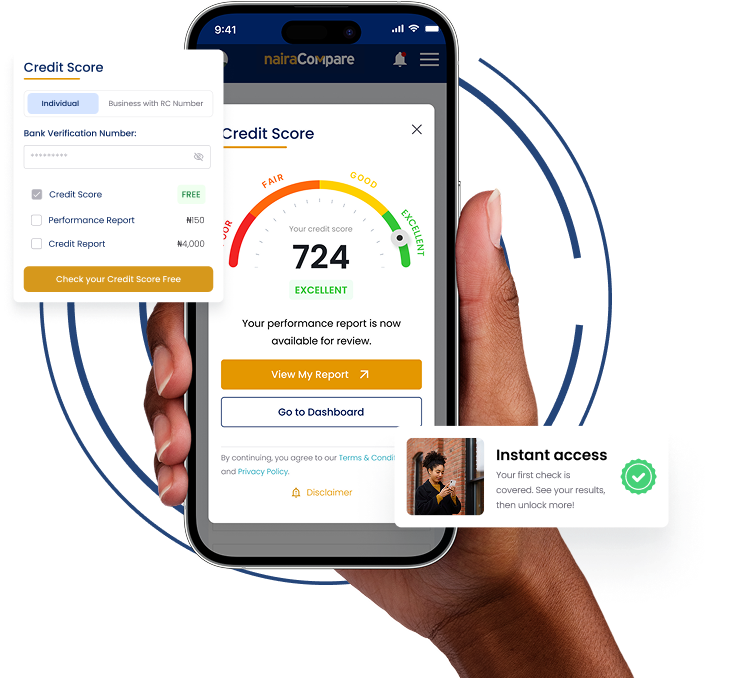
Your credit history significantly impacts approval chances and interest rates offered. Check your credit score for free through nairaCompare before applying. If your score is low, consider these steps:
- Pay off outstanding debts or negotiate payment plans
- Correct any errors in your credit report
- Build positive credit history through smaller loans repaid on time
- Wait 3-6 months if you've recently defaulted
Step 3: Prepare Required Documentation
Standard documents for most business loans in Nigeria include:
Business Documents:
- CAC Certificate (Business Registration)
- Tax Identification Number (TIN)
- Memorandum and Articles of Association (for registered companies)
- Board Resolution authorizing loan application (for companies)
- Business plan with financial projections
- Bank statements (6-12 months business account)
Personal Documents:
- Valid ID (National ID, Driver's License, International Passport, Voter's Card)
- Bank Verification Number (BVN)
- Proof of address (utility bill within 3 months)
- Personal bank statements (6 months)
- Evidence of collateral (property documents, vehicle papers, etc.)
Financial Documents:
- Audited financial statements (if available)
- Tax clearance certificates (3 years for government loans)
- Cash flow projections
- Profit & loss statements
- Balance sheet (for established businesses)
Step 4: Compare Lenders and Loan Products
Don't apply to just one lender. Compare all business loan options considering:
Interest Rates: Look beyond the advertised rate to the Annual Percentage Rate (APR) including all fees
Fees and Charges: Application fees, management fees, insurance, processing charges
Repayment Terms: Monthly, quarterly, or bullet payments? Prepayment penalties?
Approval Time: How quickly do you need the funds?
Collateral Requirements: Do you have acceptable security?
Additional Services: Business advisory, training, market linkages?
Use our comparison tool below to see side-by-side comparisons of rates, terms, and requirements across dozens of lenders:

Step 5: Submit Applications Strategically
Apply to 2-3 lenders simultaneously to increase approval odds and create negotiating leverage if you receive multiple offers.
Application Tips:
- Submit complete applications (incomplete submissions are the #1 rejection reason)
- Follow up proactively with loan officers
- Provide additional information quickly when requested
- Be honest about your business challenges and how the loan addresses them
- Highlight strong points (consistent revenue, growing customer base, repeat clients)
Step 6: Respond to Lender Queries
Lenders will likely request clarifications or additional documents. Respond within 24-48 hours to keep your application moving.
Step 7: Review Loan Offers Carefully
If approved, don't accept immediately. Review:
- Total amount to be repaid (principal + all interest and fees)
- Effective Interest Rate (EIR) including hidden costs
- Penalty clauses for late payment or default
- Prepayment terms (can you pay early without penalties?)
- Collateral enforcement provisions
- Personal guarantee requirements
Step 8: Accept and Disburse
Once satisfied with terms, sign the loan agreement. Most lenders disburse within 24-72 hours after signing, depending on loan size and internal processes.
Visit the best platforms for securing business loans in Nigeria for detailed walkthroughs of specific lender application processes.
Understanding Interest Rates and Total Loan Costs
Interest rates tell only part of the story. The true cost of a business loan includes multiple components that together determine whether financing makes financial sense.
Components of Loan Costs
| Cost Component | Description | Typical Range |
|---|---|---|
| Base Interest Rate | Stated annual percentage | 7-36% depending on lender |
| Management Fee | One-time charge (usually 1-5% of loan) | ₦50,000 - ₦500,000 |
| Processing Fee | Application handling | ₦10,000 - ₦100,000 |
| Appraisal Fee | Collateral valuation | ₦50,000 - ₦200,000 |
| Insurance Premium | Loan protection insurance | 1-3% of loan amount |
| Legal Fees | Documentation preparation | ₦50,000 - ₦300,000 |
| Late Payment Penalties | Per-day charges for missed payments | 0.5-2% daily |
Calculating Your Effective Interest Rate (EIR)
The Effective Interest Rate shows the true annual cost including all fees:
Example:
Loan Amount: ₦5,000,000
Stated Rate: 18% per annum
Management Fee: 2% (₦100,000)
Processing: ₦50,000
Insurance: 2% (₦100,000)
Tenor: 12 months
Total Fees: ₦250,000
Total Interest: ₦900,000 (18% × ₦5M)
Total Cost: ₦1,150,000
Effective Interest Rate: 23% (not 18%!)
Always ask lenders for the "all-in cost" or EIR before committing. A 12% loan with heavy fees may cost more than an 18% loan with minimal charges.
Interest Rate Outlook for 2026
Industry analysts expect lending rates to decline in 2026 as banks deploy accumulated capital into real sector financing, with current 32-36% rates considered unsustainable. This projected decline creates strategic opportunities:
For Borrowers:
- Consider variable-rate loans if you expect rates to fall
- Negotiate rate reduction clauses tied to MPR changes
- Prioritize short-term borrowing if long-term rates remain high
- Refinance existing high-rate loans when rates drop
For Business Planners:
- Factor projected rate declines into 2026 expansion plans
- Time major capital projects for mid-2026 when rates may be lowest
- Build credit history now to qualify for better rates later
Common Business Loan Mistakes to Avoid
1. Borrowing More Than Needed
Taking excess funds because "it's available" leads to unnecessary interest costs. Borrow only what your business plan justifies and can profitably deploy.
2. Ignoring Total Cost of Borrowing
Focusing solely on interest rate while ignoring fees creates unpleasant surprises. Always calculate total repayment amount including every charge.
3. Mismatching Loan Tenor with Purpose
Don't finance long-term assets (equipment, property) with short-term loans-repayment pressure crushes cash flow. Conversely, don't take 5-year loans for working capital needs.
4. Weak or Non-Existent Business Plan
Lenders need to see how you'll repay. "I have a good business idea" without financial projections leads to rejection. Learn how to assess your business needs and goals to build compelling applications.
5. Applying Before You're Ready
Submitting incomplete applications, applying with poor credit history, or approaching lenders without meeting basic requirements wastes time and damages your credit profile through hard inquiries.
6. Not Shopping Around
The first lender you approach may not offer the best terms. Comparing multiple options can save hundreds of thousands in interest.
7. Defaulting on Repayments
Missing payments destroys creditworthiness for years, blocks future financing, and may result in collateral loss. If you anticipate repayment difficulty, communicate early with lenders to restructure before default.
Success Factors for Loan Approval
Strong Financial Records
Lenders trust businesses that demonstrate financial discipline through:
- Maintained accounting records
- Regular bank account usage
- Consistent revenue patterns
- Positive cash flow history
Even small businesses should maintain basic bookkeeping. Free tools like Wave Accounting or simple Excel templates suffice if you can't afford professional accounting.
Clear Business Purpose
Vague loan requests ("for business expansion") get rejected. Specific purposes ("₦3 million to purchase inventory for confirmed December orders worth ₦7 million") demonstrate planning and show clear repayment path.
Realistic Projections
Overly optimistic forecasts raise red flags. Conservative, realistic projections backed by market research and historical performance build credibility.
Collateral or Guarantors
While business loans without collateral exist, having security significantly improves approval chances and reduces interest rates offered. If you lack collateral:
- Consider group guarantee schemes
- Explore personal guarantors
- Build your credit profile with smaller unsecured loans first
Industry and Business Maturity
Certain sectors (agriculture, manufacturing) receive priority in government programs. Established businesses (2+ years operation) have advantages over startups, though youth and women-focused programs exist specifically for new entrepreneurs.
Professional Presentation
Your application represents your business. Professionalism matters:
- Well-formatted business plan with executive summary
- Clean, organized documentation
- Prompt responses to queries
- Professional email communication
- Follow-up without harassment
The Role of Credit Scoring in Loan Access
Your credit score-a numerical representation of your creditworthiness-increasingly determines loan approval and interest rates offered.
What Impacts Your Business Credit Score
- Payment history (most important factor)
- Credit utilization (how much credit you use vs. limits)
- Length of credit history
- Types of credit used
- Recent credit inquiries
- Public records (judgments, liens, bankruptcies)
Improving Your Credit Score
- Pay all obligations on time: Set up automatic payments to avoid missed due dates
- Reduce credit utilization: Keep balances below 30% of credit limits
- Don't close old accounts: Length of credit history matters
- Limit new credit applications: Each hard inquiry slightly reduces your score
- Dispute errors: Check credit reports annually and contest inaccuracies
- Build positive history: Small loans repaid responsibly improve scores over time
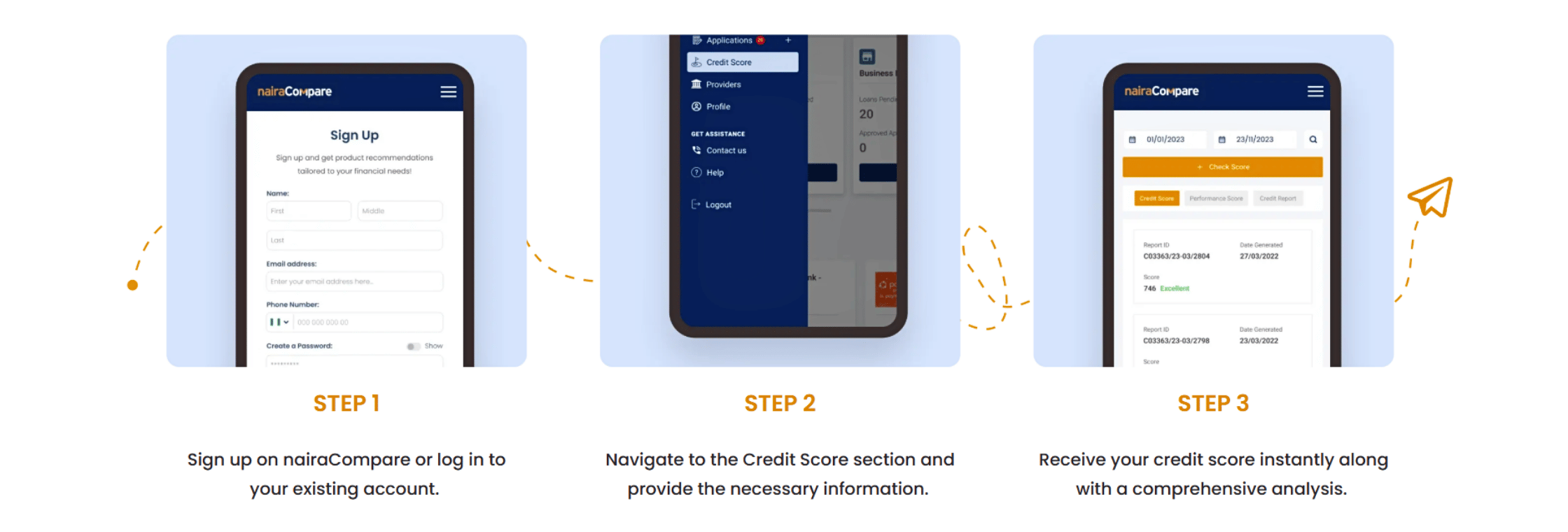
You should check your credit score now, to understand where you stand before applying for loans. nairaCompare provides free credit score checks so you can monitor your business creditworthiness. Check now:

Conclusion: Making Smart Borrowing Decisions
The key to success lies in matching your specific needs to the right financing source:
- Need affordability? Prioritize Bank of Industry, CBN intervention funds, and government programs despite longer application processes
- Need speed? Consider fintech lenders and digital platforms accepting higher costs for immediate access
- Lack collateral? Explore business loans without collateral through fintechs, microfinance banks, or unsecured commercial bank products
- First-time borrower? Start with smaller amounts from microfinance or fintech lenders to build credit history
- Established business? Negotiate with commercial banks leveraging your track record for competitive rates
Ready to compare business loan options? nairaCompare takes the guesswork out of finding the right business loan for your needs-compare rates, requirements, and approval times across dozens of lenders in minutes, all in one place.

Noella Lepdung
Noëlla Lepdung is a writer who makes magic with all sorts of content, helping businesses find their voice and meet their ambitions with cutting-edge but human-first advertising. Her portfolio features brands such as Budweiser, The Coca-Cola Company, Nivea, Leadway Group, Honeywell Foods, Monieworx, Kimberly-Clark, and WAMCO.


Other related articles


%20(1).png?width=352&name=The-Complete-Guide-for-Business-Loans-in-Nigeria-(2026-Edition)%20(1).png)