


.png?width=40&height=40&name=Rectangle%202052%20(2).png)
.png?width=40&height=40&name=Rectangle%202052%20(1).png)



-3.jpg?width=1200&height=628&name=Top%2010%20Health%20Insurance%20Plans%20in%20Nigeria%20in%202026%20(Affordable%20%26%20Reliable%20Options)-3.jpg)
%202.jpg?width=1200&height=628&name=Top%2010%20Health%20Insurance%20Plans%20in%20Nigeria%20in%202026%20(Affordable%20%26%20Reliable%20Options)%202.jpg)

.jpg?width=1200&height=628&name=Best%20Car%20Loans%20in%20Nigeria%20(2026%20Ranking).jpg)


.jpg?width=1200&height=628&name=Your%20Complete%20Guide%20to%20Comparing%20Health%20Insurance%20Plans%20for%20Businesses%20in%20Nigeria%20(2026%20Edition).jpg)
.png?width=1266&height=427&name=blog%20header%20(27).png)
.webp?width=1266&height=427&name=blog%20header%20(38).webp)
%20(1).jpg?width=1200&height=628&name=Complete%20Guide_%20Sending%20Money%20from%20UK%20to%20Nigeria%20(2026)%20(1).jpg)


.png?width=1266&height=427&name=blog%20header%20(19).png)
.png?width=1266&height=427&name=blog%20header%20(30).png)
.webp?width=1200&height=628&name=Health%20Insurance%20Cost%20Report%20(2026).webp)

%20(1).jpg)
Author Eyitemi Efole
Introduction
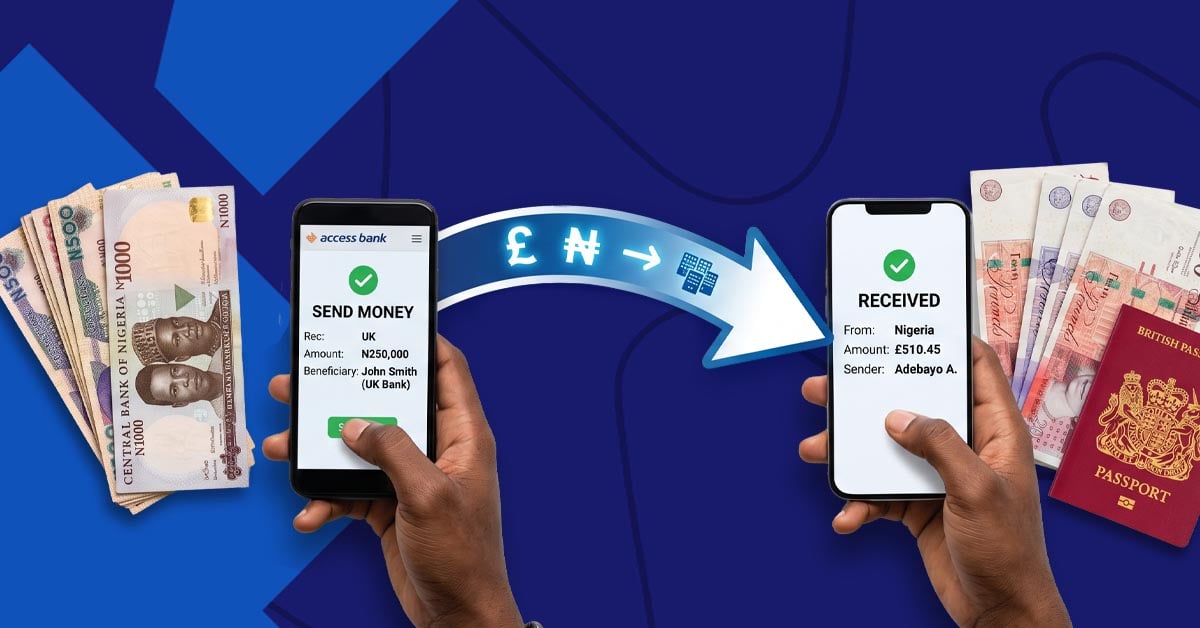
The UK is one of the largest sources of remittances to Nigeria. Hundreds of thousands of Nigerians living in Britain send money home every month, whether to support family, cover school fees, fund property purchases, or manage business payments. Yet most senders are overpaying without knowing it.
This guide is for anyone sending money from the UK to Nigeria who wants a clear, honest picture of every available option. It covers five distinct methods, from specialist digital transfer platforms to bank transfers, Bureau de Change, crypto, and mobile wallets. It explains how each works, what it costs, when it makes sense, and how to choose the right one for your situation.
Table of Contents
- Why the UK-Nigeria Corridor Matters
- How Sending Money to Nigeria Works: The Basics
- The Five Ways to Send Money from the UK to Nigeria
- Real-Life Scenarios
- What Does It Actually Cost? A Breakdown
- How to Send Money from the UK to Nigeria: Step by Step
- How to Choose the Right Method for You
- Regulatory Framework
- nairaCompare Insight
- Frequently Asked Questions
- Related Resources
- Conclusion
Why the UK-Nigeria Corridor Matters
Nigeria is one of the largest recipients of remittances in sub-Saharan Africa, and the United Kingdom is consistently among the top five source countries. For millions of Nigerian families, money sent from the UK is not supplementary income. It is the primary source of household support, school fee payments, healthcare costs, and rent.
The financial stakes of getting this right are real. On a £500 transfer at a GBP/NGN mid-market rate varies daily and is derived from global FX markets (GBP/USD and USD/NGN rates), the difference between a UK high street bank charging a 4% exchange rate markup and a specialist digital platform charging zero fees is roughly ₡37,000 less in your recipient’s account on that single transfer. Over 12 monthly transfers at £500 each, that gap compounds to over ₡440,000 a year disappearing into bank margins rather than reaching your family.
The platform you choose matters more than most senders realise. This guide gives you the information to make that choice deliberately.

How Sending Money to Nigeria Works: The Basics
Before comparing methods, two concepts are worth understanding: the mid-market rate and the difference between a transfer fee and an exchange rate markup.
The mid-market rate is the midpoint between the buy and sell prices of two currencies on the global foreign exchange market. It is the rate you see on Google or nairaCompare. No provider can offer this rate at zero cost, but the best ones come very close.
An exchange rate markup is the margin a provider adds between the mid-market rate and the rate they offer you. A provider offering ₡1,795 per pound when the mid-market rate is ₡1,850 is taking a 3% markup. This cost is invisible to most senders because it is baked into the rate rather than listed as a fee.
A transfer fee is an explicit charge listed separately, such as £2.99 or £15. Some providers charge a transfer fee and offer a rate close to mid-market. Others charge no fee but apply a markup. Comparing total cost, meaning how many naira your recipient actually receives, is the only accurate measure.
Before making any transfer, you will typically need: a valid government-issued ID for KYC verification, proof of your UK address, your recipient’s full bank account details (account number, bank name, and branch or sort code for some platforms), and your recipient’s BVN for certain regulated channels. The first transfer on any platform may take longer than subsequent ones due to verification requirements.
The Five Ways to Send Money from the UK to Nigeria
There are five practical methods for sending money from the UK to Nigeria. Each suits a different sender profile, transfer size, and priority. The comparison table below gives an at-a-glance view before the sections that follow go deeper on each.
|
Method |
Typical Cost |
Speed |
Best For |
Risk Level |
Min. Amount |
|
IMTOs |
0–3% |
Minutes to 24 hours |
Regular remittances of any size |
Low |
From £1 |
|
SWIFT/Bank |
£15–25 + markup |
2–5 business days |
Large one-off transfers; domiciliary accounts |
Low |
Varies |
|
Bureau de Change |
Negotiable |
1–3 days |
Large transfers where rate negotiation matters |
Medium |
Varies |
|
Crypto/Stablecoins |
Under 1% on-chain |
Minutes |
Tech-comfortable senders; dollar-saving recipients |
Medium–High |
No minimum |
|
Mobile Wallets |
Varies by IMTO delivery |
Minutes |
Recipients without bank accounts |
Low–Medium |
Varies |
Method 1: International Money Transfer Operators (IMTOs)
International Money Transfer Operators are specialist digital platforms licensed to move money across borders. For the UK-Nigeria corridor, they are the default recommendation for most senders. They have built their entire business around this type of transfer, which means their rates, speeds, and user experience are optimised in ways that general-purpose banks are not.
The leading IMTOs serving the UK-Nigeria corridor include Remitly, Africhange, Wise, Sendwave, Lemfi, WorldRemit, and TransferGo. Each has a different cost structure, speed profile, and feature set. Some charge zero fees and build a small margin into the exchange rate. Others charge a transparent flat fee and offer a rate very close to mid-market. The right choice depends on your transfer amount, how urgently the money is needed, and whether your recipient needs bank credit or cash.
All major IMTOs operating in the UK are authorised or regulated by the Financial Conduct Authority. FCA authorisation means your money is held in safeguarded accounts, separate from the company’s own funds, and you have access to the Financial Ombudsman Service if something goes wrong. This is your primary protection as a sender.
For a detailed ranking of the best IMTOs for UK-to-Nigeria transfers with current rate comparisons, see our supporting guide: Best IMTOs for Sending Money from the UK to Nigeria (2026).
Method 2: UK and Nigerian Bank Transfers (SWIFT)
SWIFT transfers through UK high street banks remain the most familiar method for many Nigerians, but they are rarely the cheapest. Major UK banks including Barclays, HSBC, Lloyds, and NatWest typically charge a fixed transfer fee of £15 to £25 per transaction and apply an exchange rate markup of 2% to 5% on top of the mid-market rate. On a £1,000 transfer, this combined cost can amount to £45 to £85 more than using a specialist digital provider.
SWIFT transfers make the most sense for large, infrequent transfers where an institutional paper trail matters, or where the recipient holds a domiciliary account and wants to receive the funds in pounds rather than converting to naira immediately. GT Bank has a physical branch in London where UK-based Nigerians can open Non-Resident Nigerian accounts, making it the most accessible banking option for the diaspora. Zenith Bank also participates in the CBN Naira4Dollar scheme, which provides an additional incentive per dollar received through licensed channels.
For regular monthly remittances of moderate amounts, the fees and processing times of SWIFT make IMTOs a considerably more practical choice. Reserve bank transfers for situations where the amount, documentation requirements, or domiciliary account structure justifies the additional cost.
Tip for domiciliary account holders: confirm whether the recipient’s Nigerian bank charges an incoming SWIFT fee before sending. Some Nigerian banks deduct a fee from the received amount. Ask before you send.
Method 3: Bureau de Change (BDC)
CBN-licensed Bureau de Change operators have become a remittance channel for diaspora Nigerians who want to negotiate naira conversion rates outside what banks post. The process works differently from an IMTO: you wire foreign currency from your UK bank account to the BDC’s domiciliary account at a Nigerian bank. Once the transfer is confirmed, typically within one to three business days, you negotiate and agree a conversion rate with the operator, who then pays your recipient by bank transfer or cash.
The CBN overhauled the BDC sector in 2024, reducing licensed operators to approximately 82 as of November 2025 and restoring their access to the official forex market. This restructuring improved the legitimacy of the sector, but it also means the universe of verified operators is smaller. Always confirm an operator’s CBN licence before wiring any funds.
BDCs are most relevant for larger transfers where negotiating the conversion rate is worth the additional steps. For regular smaller remittances, the complexity rarely justifies the effort over a well-rated IMTO. For further guidance on using BDCs for remittances, see our guides: The Complete Guide to Bureau de Change Services in Nigeria and How Diaspora Nigerians Can Use BDCs for Home Remittances.
Critical safety rule: only wire funds to a BDC’s domiciliary account at a reputable Nigerian bank (GT Bank, Access, Zenith, or UBA). Negotiate and confirm the conversion rate in writing before sending. Never pay cash to an unlicensed operator.
Method 4: Crypto and Stablecoins
Stablecoins, primarily USDT (Tether) and USDC, have become a practical remittance channel for digitally comfortable senders. The process involves buying a stablecoin on a licensed UK exchange, sending it to a wallet address held by the recipient in Nigeria, and the recipient converting it to naira on a local SEC-licensed exchange or peer-to-peer platform. Because the value is pegged to the US dollar, the recipient is effectively receiving dollar-equivalent savings rather than naira, which some find preferable given ongoing naira volatility.
USDT on the Tron network (TRC-20) is the most widely used option for this corridor because on-chain fees are a fraction of a dollar and TRC-20 is broadly supported by Nigerian exchanges. Network choice is critical: sending on the wrong network (for example, ERC-20 when the recipient’s exchange only supports TRC-20) can result in permanent loss of funds. Always confirm which network your recipient’s platform supports before sending, and send a small test amount first.
From January 2026, the Nigeria Tax Act 2025 classifies crypto gains as taxable income. Converting stablecoins to naira is a taxable event for the recipient. Nigeria ranked second globally in crypto transaction volume in Q1 2026, reflecting the scale of adoption, but regulatory uncertainty and platform risk remain real considerations. Crypto suits senders and recipients who are already comfortable with digital wallets and understand the risks. For straightforward monthly family support, an IMTO remains simpler, safer, and lower risk for most senders.

Method 5: Mobile Wallets and Fintech Apps
Several IMTOs now offer delivery directly to Nigerian mobile wallets including OPay, PalmPay, and Kuda, alongside traditional bank account delivery. This is not a separate transfer method so much as an alternative delivery option within the IMTO route. WorldRemit and Remitly both support mobile wallet delivery to major Nigerian fintech platforms.
Mobile wallet delivery is most useful when the recipient does not have a traditional bank account, prefers to manage money within a fintech app, or needs to access funds in a location with limited ATM or bank branch access. Transfer limits may be lower than for bank account delivery on some platforms.
There is no direct UK-to-Nigerian-wallet transfer that bypasses an FCA-regulated IMTO. Anything presenting itself as a direct wallet top-up from a UK account without an FCA-authorised intermediary should be treated with caution.
Real-Life Scenarios
Scenario 1: Adaeze, 31, NHS Nurse in London
Adaeze sends £400 every month to her parents in Enugu. She had been using her Lloyds bank’s international transfer service for two years. When she compared using nairaCompare’s send money tool, she discovered Lloyds was applying a 3.8% markup on the GBP/NGN rate plus a £18 flat fee, costing approximately £33 per transfer. Switching to Sendwave, which charges zero fees, meant her parents received roughly ₡67,000 more per month on the same £400 sent. Over 12 months, that difference was over ₡800,000 in additional naira reaching her family rather than being absorbed by bank margins.
Scenario 2: Chukwuemeka, 45, Property Investor, Manchester
Chukwuemeka needed to send £8,000 to fund a Lagos property purchase. At this transfer size, the exchange rate margin mattered far more than any flat fee. A 3% markup on £8,000 translates to £240 in additional cost, or over ₡440,000 at current rates. He used Wise, which applies the mid-market rate and charges a small transparent fee (approximately £40 on this amount), saving him significantly over both his UK bank and providers with less transparent rate markups. He kept the transaction record for both HMRC reporting purposes and the Nigeria Revenue Service under the Tax Act 2025.
Scenario 3: Tola, 27, Freelancer, London
Tola earns in both pounds and dollars from international clients. She sends money home irregularly and sometimes urgently. Her younger sister in Lagos is tech-comfortable and prefers holding dollar-equivalent savings against naira volatility. Tola sends USDT via TRC-20 to her sister’s Quidax wallet. The on-chain fee is under $1, and the transfer arrives in minutes. Both Tola and her sister understand that crypto gains are now taxable under the Nigeria Tax Act 2025, and her sister reports the conversion to naira in her annual return. For Tola’s specific situation, this method works. For senders or recipients without that level of digital comfort, an IMTO remains the safer default.
What Does It Actually Cost? A Breakdown
The following table shows indicative costs for a £500 transfer across each method. All naira figures are based on a mid-market GBP/NGN rate of approximately ₡1,850 per pound as a baseline. Actual rates fluctuate daily. Verify current rates on nairaCompare before sending.
|
Method |
Flat Fee |
Rate Markup |
Recipient Gets (approx.) |
Notes |
|
UK Bank (SWIFT) |
£18–25 |
3–5% |
₡820k–₡850k |
Costly for regular transfers; better for large one-offs |
|
Zero-fee IMTO |
£0 |
0.5–1.5% |
₡911k–₡925k |
Best for regular remittances; FCA-regulated |
|
Wise (fee-based) |
~£4–5 |
0% |
₡916k–₡922k |
Mid-market rate; best for larger transfers |
|
BDC |
Nil listed |
Negotiable |
Varies |
Rate depends on negotiation; best for large amounts only |
|
Crypto (USDT TRC-20) |
Under $1 |
~0.1% |
Depends on NGN conversion |
Network risk; taxable on NGN conversion from Jan 2026 |
Additional costs to be aware of: some Nigerian banks charge a fee for incoming SWIFT transfers, deducted from the received amount. Card-funded transfers on any platform typically cost more than bank-funded ones. Holding positions overnight if using crypto involves exchange-rate risk between purchase and delivery.
How to Send Money from the UK to Nigeria: Step by Step
These steps apply broadly across methods, with notes where steps differ.
- Check the mid-market GBP/NGN rate on nairaCompare before you do anything else. This gives you a benchmark against which to evaluate any provider’s offered rate.
- Gather your recipient’s details: full name as it appears on their bank account, bank name, account number, and for domiciliary accounts, the SWIFT/BIC code. For mobile wallet delivery, confirm the wallet platform and registered phone number. Some platforms also require the recipient’s BVN.
- Complete KYC on your chosen platform. You will need a valid government-issued photo ID (UK driving licence or passport) and proof of UK address (bank statement or utility bill). First-time verification can take minutes on some platforms or up to 24 hours on others.
- Enter your transfer details and compare the offered GBP/NGN rate against the mid-market rate you checked in Step 1. Calculate the total cost: flat fee plus the value of the rate difference. The number that matters is how many naira your recipient actually receives.
- Choose your funding method. Bank transfer is almost always cheaper than debit or credit card. Card-funded transfers incur higher processing fees across most platforms. If using a credit card, your bank may also treat it as a cash advance and charge interest.
- Confirm and save your transaction reference number. Send it to your recipient so they know to expect the transfer and can follow up with their bank if there is a delay.
- Notify your recipient and confirm arrival. Most platforms send a notification when funds are delivered, but a quick message avoids unnecessary concern.
- Keep records for tax purposes. Under the Nigeria Tax Act 2025, recipients converting crypto to naira must report the gain. For large transfers, both HMRC and the Nigeria Revenue Service may have reporting requirements. Retain transaction references, amounts, and dates.
Pro tip: if you are using a provider for the first time, make a small test transfer before sending a large amount. This confirms the delivery route works before you commit significant funds.
Pro tip: where timing is flexible, avoid sending at weekends. Some providers apply less competitive rates when interbank markets are closed. Weekday transfers during London market hours tend to offer the sharpest rates.
Pro tip: consolidate transfers where possible. Sending £500 once costs less than sending £125 four times, even on zero-fee platforms, because the exchange rate spread has less cumulative impact.
How to Choose the Right Method for You
Choose an IMTO if: you send regularly, want speed, need FCA consumer protection, and value a simple digital experience. IMTOs are the right default for the vast majority of UK-to-Nigeria senders.
Choose a SWIFT bank transfer if: you are sending a large one-off amount (£5,000 and above), need an institutional paper trail for legal or property purposes, or are funding a domiciliary account and want the recipient to hold the funds in sterling rather than convert immediately.
Choose Bureau de Change if: you are sending a significant amount and are willing to spend time verifying a licensed operator and negotiating the conversion rate directly. The overhead is not worth it for regular smaller transfers.
Choose crypto if: you and your recipient are both digitally comfortable with wallets and exchanges, the recipient wants to hold dollar-equivalent savings, and you both understand the network risk, tax obligations, and platform risks involved. This is not a beginner option.
Choose mobile wallet delivery if: your recipient does not have a traditional Nigerian bank account, or specifically prefers receiving funds in a fintech wallet like OPay, PalmPay, or Kuda.
Regulatory Framework
Understanding the regulatory landscape helps you identify legitimate providers and avoid fraud.
Financial Conduct Authority (FCA), UK: all IMTOs operating legitimately in the UK must be FCA-authorised or registered. FCA authorisation requires client funds to be held in safeguarded accounts separate from company funds, and gives senders access to the Financial Ombudsman Service for disputes. Verify any provider at register.fca.org.uk before using it.
Central Bank of Nigeria (CBN): the CBN regulates IMTOs operating in Nigeria, BDC operators, and Nigerian commercial banks receiving international transfers. A CBN circular effective May 2026 requires all licensed IMTOs to price transfers using real-time Bloomberg BMatch rates, reducing the scope for non-competitive rate manipulation. BDC operators must hold a current CBN licence. Verify BDC licences at cbn.gov.ng.
Nigeria Tax Act 2025 (effective January 2026): forex trading profits and crypto gains are now classified as taxable income for Nigerian tax residents. Converting stablecoins to naira is a taxable event. Recipients with significant crypto-to-naira conversions should register for a Tax Identification Number and file an annual self-assessment return by 31 March. This is not financial advice; consult a qualified tax professional for guidance specific to your situation.
HMRC (UK): large international transfers may trigger reporting requirements or questions from HMRC, particularly if the funds are connected to property, business income, or assets held abroad. Retain records of all significant transfers.
Securities and Exchange Commission Nigeria (SEC): the SEC regulates Virtual Asset Service Providers under the Investments and Securities Act 2025. Only use SEC-licensed exchanges in Nigeria for crypto-to-naira conversion. Quidax was the first SEC-licensed VASP in Nigeria; Busha, Luno, Breet, and Yellow Card are among the other licensed platforms as of 2026.
nairaCompare Insight
For Nigerians in the UK sending money home monthly, the platform you use is a financial decision that compounds over time. At current mid-market rates, the difference between a UK bank charging a 4% markup and a specialist IMTO charging zero fees is roughly ₣74,000 per £1,000 sent. Over 12 monthly transfers of £500 each, that gap can add up to ₣444,000 or more in additional naira reaching your family rather than disappearing into bank margins. That is a meaningful amount at any income level, and the fix takes less than five minutes: compare on nairaCompare before every transfer.
For Nigerian professionals and business owners in the UK handling larger or less frequent transfers, the exchange rate margin is the dominant cost, not the flat fee. On a £5,000 transfer, a 3% markup costs £150, or over ₣277,000 at current rates, more than a provider applying the mid-market rate with a £30 flat fee. Wise’s transparent mid-market approach makes it the easiest benchmark for larger transfers. For transfers above £2,000, always compare Wise against the zero-fee IMTOs on total naira received, not headline fees. And from January 2026, keep records of all significant transfers for both HMRC and Nigeria Revenue Service purposes under the Tax Act 2025.
Frequently Asked Questions
What is the cheapest way to send money from the UK to Nigeria right now?
It depends on your transfer amount and delivery preference. For most regular remittances, zero-fee IMTOs such as Africhange, Sendwave, and TransferGo offer the best combination of cost and speed. For larger one-off transfers above £2,000, Wise’s mid-market rate approach frequently delivers the best total value. Compare your specific amount on nairaCompare before every transfer, as the best provider changes with market rates.
How long does a UK to Nigeria transfer take?
Express IMTO services deliver within minutes to a few hours. Economy options take one to five business days. SWIFT bank transfers take two to five business days. BDC transfers take one to three days after the wire is confirmed. Crypto transfers on TRC-20 typically arrive within minutes.
Are IMTOs safe to use?
Yes, provided they are FCA-authorised. FCA authorisation requires client funds to be safeguarded separately from company funds, and gives you access to the Financial Ombudsman if something goes wrong. Always verify authorisation at register.fca.org.uk before using any provider.
What details does my recipient need to receive money in Nigeria?
For bank account delivery: full name as it appears on the account, bank name, ten-digit account number, and for some platforms, BVN. For domiciliary accounts receiving SWIFT transfers: the bank’s SWIFT/BIC code. For mobile wallet delivery: the wallet platform name and registered phone number.
What is the difference between the mid-market rate and the rate my provider offers?
The mid-market rate is the midpoint between global buy and sell prices for GBP/NGN. Most providers offer a rate below this and keep the difference as profit. A provider offering ₡1,795 when the mid-market rate is ₡1,850 is applying a 3% markup. Always check the mid-market rate on nairaCompare before accepting any provider’s rate.
Do I pay tax on money sent to Nigeria from the UK?
Sending money to Nigeria is not itself a taxable event in the UK. However, if the funds represent income, business proceeds, or gains on UK assets, those may have separate tax implications. Consult a qualified tax professional for guidance specific to your circumstances. HMRC may ask questions about large or frequent international transfers.
Does my recipient in Nigeria pay tax on money I send them?
For straightforward family remittances received into a Nigerian bank account, there is generally no income tax on the receipt. However, if your recipient is converting crypto to naira, the conversion is a taxable event under the Nigeria Tax Act 2025. Recipients with significant crypto conversion activity should file an annual self-assessment return.
How do I know if an IMTO is legitimate?
Check the FCA register at register.fca.org.uk. Any provider claiming FCA regulation that is not on the official register is misrepresenting itself. Legitimate providers never contact you unsolicited on social media. If someone approaches you with a transfer offer, it is almost certainly a scam.
What is the best option for sending large amounts (£5,000 and above)?
For large transfers, the exchange rate margin matters more than flat fees. Wise’s mid-market rate approach is the most transparent benchmark. For very large amounts with a paper trail requirement, a SWIFT transfer via a Nigerian bank’s domiciliary account may be appropriate. For amounts where rate negotiation is worthwhile, a CBN-licensed BDC is an option, provided you verify the operator’s licence before wiring any funds.
Can I send to a Nigerian mobile wallet from the UK?
Yes, via IMTO platforms that offer mobile wallet delivery. WorldRemit and Remitly support delivery to OPay, PalmPay, and Kuda wallets. There is no direct UK-to-wallet transfer that bypasses an FCA-regulated IMTO.
Conclusion
Sending money from the UK to Nigeria has never been more competitive, but only if you choose the right platform. IMTOs have cut fees to zero, applied mid-market rates, and reduced delivery times to minutes. SWIFT remains useful for large institutional transfers. BDCs serve senders who want to negotiate directly. Crypto works for the digitally comfortable. The right method depends on how much you are sending, how urgently it is needed, and how much complexity you are willing to manage.
The single habit that makes the biggest financial difference for most UK-to-Nigeria senders is comparing providers before every transfer. Exchange rates shift daily, and the provider that was cheapest last month may not be cheapest today. Use the nairaCompare send money comparison tool to check which platform delivers the most naira for your pounds before you confirm any transfer.
Exchange rates are indicative and subject to change. Always verify current rates using the nairaCompare send money comparison tool before making any transfer. All listed IMTO providers are FCA-authorised or operate under FCA-licensed financial partners. Regulatory information is current as at the date of publication and subject to change. This content is for informational purposes only and does not constitute financial or tax advice. Consider consulting a licensed financial adviser or qualified tax professional for guidance specific to your situation.

Eyitemi Efole
Eyitemi Efole is exploring the marketing field, with a particular interest in brand management, strategy, and operations. She is keen on understanding how brands build trust and connect meaningfully with their audience.


Other related articles


-2.jpg?width=352&name=What%20is%20a%20Good%20Interest%20Rate%20on%20a%20Savings%20Account%201%20(1)-2.jpg)